Sunday, November 12, 2006

Are Christians Judgers and Hypocrites?


If you've ever said (or heard someone say), "Christians are nothing but judgers and hypocrites", let me point out something interesting about that statement. In order to identify Christians (or any group of people) as "judgers", you would yourself be making a judgment. Also, if you think judging others is wrong and you go ahead and make such a statement, you would also be proving yourself to be a hypocrite. It's like whispering in someone's ear, "I know someone who's a terrible gossip. Guess who it is."

But are Christians judgers and hypocrites? I don't know. Possibly some of us are. I think every single person has, at some point, been guilty of judging someone else unjustly and also guilty of acting in a hypocritical way. Christians certainly haven't cornered the market on judgmentalism and hypocricy. In fact, I bet that if I asked you, my reader, if you've ever acted hypocritically (either intentionally or accidentally), there's really only one way to answer: "Yes." If you said, "No, I've never been a hypocrite," you'd most likely be lying and, thereby, proving yourself a hypocrite. Am I right?

I think, however, the main issue behind these accusations is the dissatisfaction and dissapointment so many have faced when they, in good faith, have trusted Christians with something and have been let down or mistreated in some way. The truth is this: Christians are humans and are, therefore, capable of great wrongs. If you are looking for a reason to shoot down the idea of Christian perfection, then watching the Christians would, unfortunately, give you a lot of ammunition. Why? Because Christians aren't perfect. If they claim to be, then they're lying. (For the record, I haven't, as of yet, heard any Christian claim to be perfect.) However, if you're looking to shoot down Christ and His message, don't look at Christians. Look at Christ.

Thursday, October 19, 2006

Using the Bible to Verify Itself


"McDowell is in fact doing nothing more than using the New Testament to confirm the New Testament; an obvious case of circular reasoning and utter sophistry." Freethinker's Textbook, pp. 193-194

I find this criticism a lot in secular circles and while I understand the concept that you can't use a single source to verify itself, let me clarify something. The Bible (or even the New or Old Testaments) is not a single source. It wasn't written by one person. It isn't even one book (although today it's bound together to look like one). It wasn't written within the same century or even the same millennium. There are an estimated 44 authors, 66 separate historical texts, and the documents span approximately 1500 years. Furthermore, the methods of preservation, record-keeping and maintenanc of textual accuracy far exceed those required to verify the authenticity of any other ancient historical texts. So, can it be used to verify itself? Certainly it can! There are extra-biblical records, as well, of course. Josephus is one, Pliny the Younger is another (anti-Christian, actually), and there are more.

Keep in mind that modern historians require three primary sources in order to confirm the details of any past event. They use things like newspapers, letters, scientific evidence, eye-witness accounts, etc. The closer to the event, the more reliable the source, and eye-witness accounts are the best of all. When it comes to Jesus's resurrection, for example, (which is the single most important event for all Christian belief--I Cor. 15:17) the Bible provides us those three eye-witness accounts written by people who were actually there (Matthew, John, & Paul). And it is recorded that more than more than 500 people saw the risen Christ, many of them named. Nearly all of them were still alive at the time the account was being circulated, and not one ever came forward to refute the account.

But, that's not all. We also have original manuscripts preserved in their entirety that can be scientifically verified as authentic. So, not only does the "circular reasoning" argument not hold water, it quickly reduces to absurdity. It suggests that nothing can be believed without MORE than three, verified, authentic, eye-witness accounts. In that case, we would have to say good-bye to nearly every news and historical source we have today.

Recognizing the truth in the Bible (because we CAN use one book of the Bible to verify another) certainly does not depend on circular reasoning. Jesus doesn't need to rely on circular reasoning to entice people to believe. He didn't say, "I'm God because I said so." Though He claimed to be God, the Messiah, He also said, "Do not think that I have come to abolish the Law or the Prophets; I have not come to abolish them but to fulfill them." (Matthew 5:17) Jesus was referring to His fulfillment of prophesy. Since He fulfilled nearly 300 of them, I'd say that was enough extra evidence to back up His claim. (See this post.)

Tuesday, October 10, 2006

Does Freedom Exist?


Many people mistakenly think that anything that makes you experience more freedom must be a good thing. This faulty reasoning is used as the justification for all kinds of harmful practices. Unlike truth, freedom is a relative thing. There is no such thing as absolute, total freedom. People are not designed, either physically, emotionally, spiritually or otherwise, to be capable of experiencing such a thing. Let me explain why:

Freedom is not a self-defining thing, nor is it self-sustaining. In order to be free, you must be free "of something". For example, even though our country offers us many freedoms, we are still not free from our obligation to its laws. In a sense, we are held captive by the laws of this nation. If we decided we wanted to be free from the laws of America and overturned the goverment until there only anarchy remained, would we then be finally free? Certainly not! It would be then that the freedoms that matter would be stripped from us--such as the freedom to enjoy security, orderliness and a life free of fear. Freedom, then is relative. Being "captive", then is also relative. What matters most is this: To what are we being held captive?

Let's bring this onto a spiritual plane. Is spiritual freedom possible? Is it more "free" to believe in a God to whom you dedicate your entire existence, or more "free" to choose not to believe in God and lead your own life? I can certainly see the reasoning behind the argument for the latter and have heard it often. Starting from a point of non-belief, it would seem much more freeing to believe in no God. Also, if one was following a religious system and became disillusioned with it, choosing to deny God would also feel very freeing. However, again we must ask ourselves, what am I being freed from? And, having made my choice, what am I now captive to?

If God exists, made us, loves us and desires a fully, open, dynamic, growing relationship with us--one in which we give Him our complete love and trust--what would that mean? Would this be freeing or enslaving? Well, is marriage freeing or enslaving? It greatly depends on the marriage, I would say. I was once in a relationship that was all about enslaving. It was unhealthy and there was no freedom in it. Now, however, my relationship with my husband gives me a great abundance of freedom. I am free to laugh, love and be who I am--knowing that he will always love me, too. The knowledge that he is my support and my provider and my security is also greatly freeing--I am no longer captive to fear or worry about the future. The knowledge that he is my lifelong companion is also immensely freeing--I don't have to worry about loneliness or having to go through future struggles alone.

It stands to reason then, that if God made us and loves us, it would be more freeing to follow Him, rather than our own limited knowledge and corrupted reasoning. After all, if He designed our makeup--the intricasies of our thought patterns, the infinite variables of our spiritual and emotional needs, and every other minute, seemingly unimportant fraction of our essense--who better to guide us into the best path for our ultimate, holistic well-being?

Wednesday, October 04, 2006

How can I be sure?


Atheists and Christians alike want to know how a Christian can be absolutely sure that Jesus is who He said He was, that He actually rose bodily from the dead and that He is coming again one day. We want to be sure, because, let's face it: if we're wrong, we're wasting our time, aren't we? We want to be sure because we don't want to die only to find out that some obscure cult in California had it right all along and our souls are now forever trapped in some celestial dump heap. We want to be sure because we don't want to spend our entire lives trapped in fear.

So, how can I know for sure? Does such assurance exist for the thinking, reasonable person? And if it does, how much does faith play in?

To answer these questions, here are several realities you must consider first:

1. There is such a thing as absolute truth. Truth is not relative. If something is true, it is universally true. My belief or lack of belief has no impact on what is already true (or untrue). Truth exists independently from my perceptions. Truth not only exists, it is knowable. (You will find that both Christianity and the scientific community uphold all of these statements.)

2. There are such things as right and wrong. Universally, people operate on a system of ethics/right and wrong/morality. Though there are extremes, most people can even agree on what is right and wrong. For example, is molesting a child right or wrong? How do you know it's wrong? You just know. Every fiber of your being screams against it, because you were designed to operate within a system of ethics. Even hardened criminals have ways of justifying their actions. If they didn't really operate on a system of ethics (though, granted, it could be very skewed), why bother justifying it at all? Even if they completely lost their conscience and no longer justify their actions, they still believe they are doing right by serving the highest "good" they know--themselves. All people are driven by this internal moral indicator. It can be skewed; it can even be reversed, but it cannot be escaped.

3. If God is a reality, He would control what information about Himself is available to me. In other words, He would reveal spiritual truth according to His own standards. Therefore, any spiritual truth I know and believe must have come from God. Therefore, if I desire spiritual truth, I should seek God for it.

4. If God is a reality, He defines Himself. In other words, His existence, His nature and His message to me must come from Him. I'm not going to be able to figure it out on my own. If I look for God based on my limited perceptions, I'll never find Him. God is a Being who's identity is not up to my choosing.

If you want to look at some other areas of philosophical interst along these lines, go to my earlier blog entry: 10 Theoretical Statements Christians and Atheists Can Agree On.

But for now let's get back to the main question: How Can I Be Absolutely Sure That Christianity Is True?

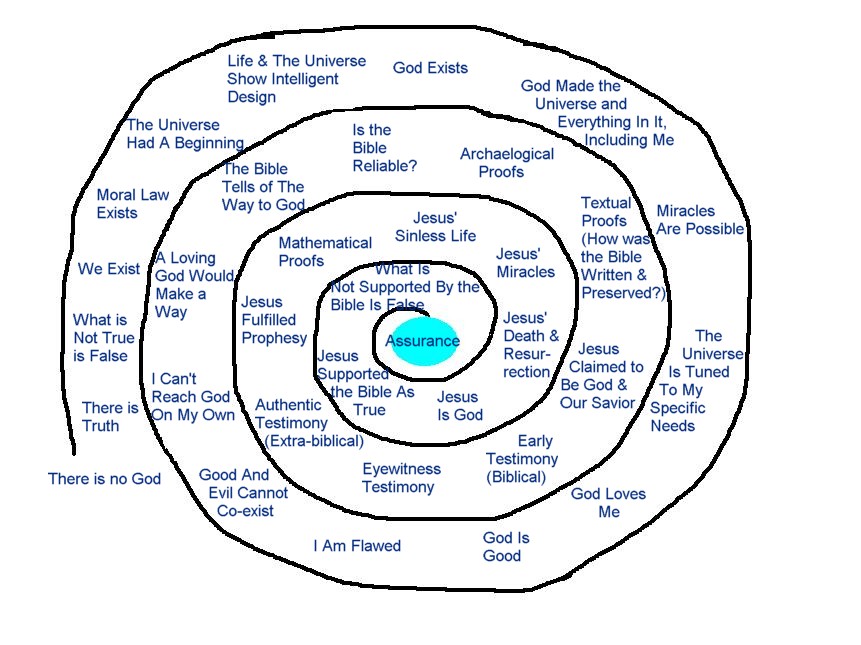
There is something called Spiral Reasoning. The idea is that you start with a knowable bit of information and you use philosophy, history, physical evidence, testimonial evidence, archaelogical evidence, etc... --always building on what you already know, one step at a time, until you reach the point where you are convinced of the truth. This will take time, mental energy and emotional energy, but the reward far outweighs the cost. I have included a diagram below that shows the steps that one might follow toward compelete assurance of Christ's existence, His sacrifice and His offer to you. It also shows the steps one takes to establish biblical reliability and the accuracy of historical records. (Unfortunately, it is pretty small on-screen, so you may have to download it or print it in order to read it properly. Sorry about that--but it's just another step in your search, right?)

How much faith is involved? I think that's a question only you can answer. Some people need more factual proofs. God knows that and made sure that there would be plenty available. Other people need very little evidence to beleive and are able to take more on faith. Regardless of where you fall within this spectrum, some amount of faith will be required. (Not, however, any more faith than is required to believe any of the alternatives.)

If you are a confirmed skeptic, it's unlikely that anyone, in a few minutes could give you everything you needed to know in order to fully believe in Jesus Christ. However, a skeptic should be a skeptic for a reason, right? If you haven't given the evidence a thorough look, how authentic would be your stance?

The fact is this: assurance--complete assurance is not only possible, it is what God desires for each of us. He made sure there was ample, abundant, over-flowing evidence to support the truth of His existence, His message and His offer to us. Won't you have a look?

Spiral Reasoning

Monday, September 25, 2006

Changing Perspective


Not long ago I was dressing up for some event and wanted to wear a certain pair of earrings. I went to get them from my jewelry box only to discover that one of them was missing. I looked all over the dresser and the floor, but couldn’t find the other one, so reluctantly chose a different pair. A couple of days later, I went through a similar search, but left frustrated. Later, I came back and decided to do a more thorough search. I searched the floor, felt under the cabinet and looked under the bed. I picked up everything on my dresser and looked under it. I rifled through every item there, but still couldn’t locate that crazy, rotten, little earring that now seemed to be hiding from me on purpose. I decided to give up again. I turned to go, but as I did so, took one last glance in the mirror. Suddenly, there it was! Right there, in the mirror, hanging from the backside of one of my glass candleholders, was my lost earring! How it got there, I didn’t know, nor care. I had finally found it!

Strange how we can be looking for something—even diligently searching for it—but it can still continue to elude us. I never considered using the mirror as a way to enhance my search—as a way of gaining a different perspective. And yet, even though I only changed my perspective for only a brief moment, my eyes immediately spotted the object of my search. I think our search for God can be very much like my search for my lost earring. We keep a picture in our mind of what we think He’s like, hoping that when we come across Him we’ll recognize Him. We look everywhere we think He might be hiding, only to discover He isn’t in any of those places. We become frustrated—even angry—that He is hiding from us (on purpose, of course) and decide to give up.

Consider for a moment, a different perspective on this issue. Consider the possibility that God isn’t hiding from us. Consider the possibility that God is actually trying to get our attention. Consider the possibility that the picture we have in our mind of what God is like is so flawed that we simply aren’t able to recognize Him when He shows Himself to us. I invite you to evaluate some of your ideas about God—recognizing them for what they are—and then try to think about them with me from a slightly different perspective. Perhaps, like my lost earring, God has actually been in plain sight all along.

Wednesday, September 13, 2006

"Don't Judge Me."


I was watching a show the other day, called The Secret Lives of Women (one I probably shouldn't have been watching, truth be known) about "swingers"--couples who have sex with other couples. See, I always thought the word "swinger" meant someone who liked to dance a lot. Shows how naive I can be. Anyway, they engage in group sex, trans-gender sex, etc... I watched it until the end, waiting to see if they ever came on with a disclaimer of any sort about the ramifications of such a lifestyle. They didn't--not at all. Everything said was in full support of it. One lady actually said, "If you have a good marriage, this [having multiple sex partners] can make it stronger." (She wasn't married, by the way.) There were no warnings and barely a bit of cautionary advice. On the contrary, they were actually trying to get more people to try this lifestlye. Then, at the end, each of the three ladies got a chance to give her last little plug for swinging--and this is what one of them said, "People sometimes think what we do is immoral. It makes me sad when people judge me that way."

Whoa! Wait a minute! Since when do "thinking" and "judging" have the same definition? Who is judging her just by thinking that what she's doing is wrong? If I think murder is wrong does that mean I'm actually passing judgment over murderers? Certainly, not! What a rediculous notion! Furthermore, there are two completely different subjects here--the person and the act. She is insinuating that just because someone thinks her actions are wrong, that they are somehow passing judgement on her, the person. Nope! Two different mental functions entirely.

So, where does this idea come from? People have taken a verse out of the Bible and maligned it nearly beyond recognition. Here's the verse (in context, for a change):

Matthew 7:1-5 Jesus said, "Do not judge, or you too will be judged. For in the same way you judge others, you will be judged, and with the measure you use, it will be measured to you. Why do you look at the speck of sawdust in your brother's eye and pay no attention to the plank in your own eye? How can you say to your brother, 'Let me take the speck out of your eye,' when all the time there is a plank in your own eye? You hypocrite, first take the plank out of your own eye, and then you will see clearly to remove the speck from your brother's eye."

Obviously, the "judging" referred to here has absolutely nothing to do with ignoring immorality (as Miss Swinger on the show seemed to believe), or Jesus wouldn't have gone on to give the proper method for helping a brother out of immorality. In fact, He doesn't even say, "Never judge". It actually seems like He's giving us guidelines to do it in correctness of heart. Still, since we rarely have perfectly pure intentions, it's safe to assume that this kind of judging is usually not a good idea--especially in light of the warning that He gives that if we act hypocritically, it will come back to bite us on the butt. It is clear, though, that we are supposed to help each other knock bad habits and encourage each other toward right living--just making sure that what we do is out of love and from a correct perspective (i.e. not being ourselves entrapped in the sin, therefore making ourselves hypocrites.) There are many passages, actually, that discuss this.

I went ahead and looked up the word for "judge" in this passage in the original Greek. The word is κρίνω, pronounced"kree-no", meaning: "distinquish, i.e. decided (mentally or judicially); by impl. to try, condemn, punish:--avenge, conclude, condemn, damn, decree, determine, esteem, judge, go to (sue at the) law, ordain, call in question, sentence to, think." Most of these words imply some kind of passing of judgement upon another person, as in condemning them, either mentally or in deed. We understand that we're not supposed to do that--that is, pass judgement upon others (the people) . This would be kind of like saying, "You're going to hell for that." Not only is such a phrase unlikely to receive any positive, healthy response, it isn't especially accurate, either.

Now that we know what we're not supposed to do, let's look and see what attitude we're suppposed to have toward the "act"--sinfulness. Notice, too, the context:

Romans 12:9-10 "Love must be sincere. Hate what is evil; cling to what is good. Be devoted to one another in brotherly love. Honor one another above yourselves."


"Hate what is evil." Now, that's a pretty strong phrase. We're not supposed to ignore it, make excuses for it or pat it on the head. We're supposed to HATE it! Hate what is evil! How are we supposed to know right from wrong, though, if everyone around us is saying, "When you think what I'm doing is immoral, that means you're judging me"?


Here's a tip to survive this life and this century with your conscience intact: "DON'T ALLOW ANYONE TO STRIP AWAY YOUR ABILITY TO DISCERN BETWEEN RIGHT AND WRONG!"


I admit it: I think what these people on the show were doing is morally wrong. Not only that, it made my skin crawl; it was highly disgusting. The thought of sharing my husband with several women and a few men would be enough to make me go into a naseau coma, if there were such a thing. It's wrong; I hate it. But, I don't hate those people. Actually, quite the contrary, I wish for only their best. (Of course, my idea of what's best--a loving, open, dynamic relationship with God--and their idea of what's best--great sex with whoever walks in the door--are two different things.)

If it's wrong; it's wrong. Avoid it. You don't have to berate anyone else about it; just make sure you and those in your care avoid it. Don't apologize for your standards. Don't sacrifice your conscience on the altar of Political Correctness. Remember, "If you don't stand for something, you'll fall for anything." That statement is very true. There's a trend in this nation that's telling us that truth is relative. "There's no absolute truth." Well, even that statment, "There's no abosolute truth", is an absolute statement. Recognize fraud when you see it. It's there.

Honestly, though, the only way you're going to keep a healthy conscience is to give it into the keeping of the only One who is truly good--God. We can be deceived; God can't be.

Wednesday, September 06, 2006

The Cost of Following Jesus Christ


How much does it cost to be a Christian--a "follower of Jesus Christ"? Nothing and everything. The gift of God's forgiveness and acceptance is completely free, but also carries the highest price--your love and your trust.

This is a concept that is often misunderstood in non-Christian circles. Of course, it's not surprising, since they hear: "Jesus' love and forgiveness is a free gift", but then they see us going to church regularly, participating in all kinds of service projects, denying ourselves certain worldly pleasures and giving vast amounts of money to various Christian organizations. Sure seems like there's a price to me!

Here's an example, though, that might help clear this up a little:

We are like a baby bird in a nest. The nest is our comfort zone, where we can do whatever we like without having to believe in anything else or trust in anyone else (except for Mamma bird, but she just seems to show up at the right times and we don't know why--like our dependence on this beautiful world we live in).

However, eventually we must make a choice: leave the nest, get out on the branch where we're much less comfortable, or stay in the nest for the rest of our lives and stagnate. The choice is free to us and a relatively safe one. Yes, a great gust of wind could come up and knock us out of the tree, but while crawling out of the nest onto the branch, we're, at least, still on solid territory. This is like accepting Christ. It takes a step of faith, a risk. All we have to do, though, is to believe in Him--to accept His forgiveness for our sins, to trust in His promises to meet us where we are and to grow us in Him throughout the days, weeks and years to come--to never leave us. At that moment, sitting there on the branch, we're what Christians call "saved". All of the mysteries and promises and gifts of God are, at that moment, fully available to us. We are in His grace and in open communication with God. If we were to die at that moment, heaven would be ours, no matter what misdeeds we'd committed in the past.

But, let's say we don't die then--at the moment of belief. What happens next? Here's where the cost comes in. We're sitting on that branch, out of the nest, but very worried about what comes next. Well, then Mamma bird (God) comes up behind us and gives us a nudge. We fight back, not wanting to leave our safe perch, and we somehow manage to keep our talons securely on the branch. Being out of the nest is enough, right?

Mamma bird gives us another nudge. This time she's more insistent. We fight back and scoot farther down the branch away from her. What is she trying to do, anyway? Kill me? Hasn't she seen how far a drop it is? She must be nuts!

Again, though, here she comes! We brace ourselves, but this time she nudges us so hard that we loose our grip and start to fall. Is this why we got out of the nest? Just to fall? What a terrible trick! But then something happens that we didn't expect. We realize that we have wings. We open them and begin to fly. Suddenly, we realize that sitting in the nest and sitting on the branch were nothing compared to the miracle of flight! What glory! What exhilaration! So, this is what Mamma wanted for us all along!

Is there a cost? Certianly! It costs you everything! It costs your love, your trust and your utter dependence. What is there in life that has more value than these things? I can't think of a thing. This is what God demands from us--everything of value.

When we say that there's no cost, we mean that belief is a choice that you make. It doesn't cost you any money; it doesn't cost you good works; it doesn't cost you any time; it doesn't cost you any fixing up of yourself beforehand. The gift is free in this regards, because love and trust are not a commodities. God will accept you exactly how you are at that moment, no matter what you've done in the past or how you are choosing to live your life today. ...But He won't leave you how He finds you. He desires so much more for your life! He wants us to fly--no, soar! Can you trust Him to guide you one step at a time?

Monday, August 28, 2006

Spiritual Thought 8: Is Freewill Possible If God Knows the Future?

I've come across this discussion several times lately. I've heard people say that if God knows the future, then there couldn't be any such thing as free will. If He already knows what we're going to choose before we choose it, and bases His plan for our lives accordingly, then we didn't really have a choice at all. However, this logic is faulty, and here's why:

Consider a similar example:
I know my 9-year-old daughter very well. I know that she doesn't like gravy on her meat or mashed potatoes and she doesn't like dressing on her salads. She eats them both dry. Don't ask me why; it's strange, I know. (But it's more healthy, so I don't push it.) Still, whenever we have salad or mashed potatoes, I ask, "Do you want gravy?" or "Do you want some dressing?" It's on the table and it's available to her if she chooses to have it. I know, though, that she will say, "No, thanks." So, if she chooses against the dressing or the gravy, does that mean she wasn't excersizing free will, just because I knew in advance what she was going to do? Certainly, not! She always has the option of choosing differently than she normally does. If she, one day, said, "Yes, I think I'll try some Ranch dressing today," would I say, "Oh. Actually, you can't have any. I was just joking."? Of course, not. I would pass her the dressing with my compliments.

Knowledge does not equal choice. It never does. Can you come up with an example of when knowing something equals choosing something? I can't. They are two completely different mental functions. Even in extreme cases, they are different. If you are standing next to a bomb that is about to explode, you have a choice: run or stay put. Just because we know most people would run, doesn't mean that a choice wasn't made in that instant.

So, knowing that my daughter will turn down the dressing, does that mean I'm choosing not to allow her to have it? No. Just because God knows the future doesn't mean He's making our choices for us. Even by making a plan in accordance with our choices, He still is allowing us free will. I still have a wide variety of salad dressing choices in my frig. If she ever changes her mind, I'm prepared.

Here's another example: Let's say you are a new student looking for a college to attend. Both Yale and Harvard accept you into their schools. You have a choice to make. Let's say that God knows that you are going to choose Harvard. He also knows that there is a wonderful person there that you are going to meet and eventually marry. So, does that mean that you don't have a choice? Does that mean that if you chose Yale, that they'd say, "Oh, whoops! The letter we sent you had a typo. We meant to say, 'You're NOT accepted.' Sorry." No. So, what if you chose Yale and ended up going to Yale? Did you thwart God's plan? No. He knew you'd choose Yale, in that case, and there's probably a special person waiting for you there, instead. Just because our choices don't derail God's plan doesn't mean that we're not really choosing. Neither does it mean that God is choosing for us.

I think, possibly, one reason we don't like the idea of God's foreknowledge is because we feel trapped into a certain path--like if someone knows what we're going to choose, our choices don't really matter. This is a limited way of thinking--learned through our dependence on our linear existence. It is uncomfortable and confusing to try to think of anyone, even God, living outside of linear time. It's time, though, to stop trying to limit God. If you're going to understand anything about Him, you have to allow for His biggness--that He is not held within our limits.

I think we also don't like the idea that our poor choices rest solely on our own shoulders. We kindof like the idea that God planned for us to make the mistakes we're making, thus eliminating any personal responsibility. We think, "If God is to blame for my poor choices, then He couldn't punish me for them." Two problems here: 1, God's purpose is not to punish, but to save. 2, Freewill is possible; therefore, our choices are ours alone. No one else can be blamed for them. It's time we own up to our own failures. It's the only way we will ever learn to see our lives from a right perspective, and it's the first step towards finding forgiveness, peace and hope.

Friday, August 18, 2006

Just a Few of the Prophesies Concerning Jesus


Prophesies and Fulfillments of Jesus’ Life, Death and Resurrection
(Taken from Evidence That Demands A Verdict, by Josh McDowell)

In the Old Testament (written by many different men over a span of approximately 2,000 years) there are over 300 references to the Messiah (God’s promised Redeemer of mankind) that were fulfilled in Jesus. Here are a few. Notice the dates of the prophesies and keep in mind that those who recorded these fulfillments of the prophesies were all martyred (terrible deaths), still proclaiming their belief in Jesus Christ.
Prophesy 1
Jesus would be born of a virgin.
“Therefore the Lord Himself will give you a sign: Behold, a virgin will be with child and bear a son, and she will call his name Immanuel.” Isaiah 7:14 (approx. 670 B.C.)
Fulfillment
“…Shall was found to be with child by the Holy Spirit. And Joseph… kept her a virgin until she gave birth to a Son; and he called His name Jesus.” Matthew 1:18, 24, 25; Luke 1:26-35
Prophesy 2
Jesus would be called Immanuel
(Isaiah 7:14, above)
Fulfillment
“The virgin will be with child and will give birth to a son, and they will call him Immanuel”—which means, ‘God with us.’” (Matthew 1:23)
Prophesy 3
Jesus would be the Son of God
“I will surely tell of the decree of the Lord: He said to Me, ‘Thou art My Son, Today I have begotten Thee.’” Psalms 2:7 (approx. 1000 B.C.) (see also I Chronicles 17:11-14; II Samuel 7:12-16)
Fulfillment
“…And behold, a voice out of the heavens, saying, ‘This is My beloved Son, in whom I am well-pleased.’” Matthew 3:17 (See also Matthew 16:16; Mark 9:7, Luke 9:35; 22:70; Acts 13: 30-33; John 1:34, 49)
Prophesy 4
Jesus would be of the Tribe of Judah
“The scepter shall not depart from Judah, Nor the ruler’s staff from between his feet, Until Shiloh comes, And to him shall be the obedience of the peoples.” Genesis 49:10 (approx. 1406 B.C.) (See also Micah 5:2)
Fulfillment
“Jesus…the son of Judah…”
Luke 3:23, 33 (See also Matthew 1:2; Hebrews 7:14)
Prophesy 5
Jesus would be of the house of David
“ ‘Behold, the days are coming,’ declares the Lord, ‘When I shall raise up for David a righteous Branch; And He will reign as king and act wisely And do justice and righteousness in the land.’”
Jeremiah 23:5 (approx. 580 B.C.)
(See also II Samuel 7:12-16; Psalms 132:11)
Fulfillment
“Jesus… the son of David…” Luke 3:23, 31 (See also Matthew 1:1; 9:27; 15:22; 20:30, 31; 21:9,15; 22:41-46; Mark 9:10; 10:47,48; Luke 18:38,39; Acts 13:22,23; Revelation 22:16)
(Jesus was a descendent of King David on both is mother’s and father’s side.)
Prophesy 6
Jesus would be born in Bethlehem
“But as for you, Bethlehem Ephrathah, Too little to be among the clans of Judah, From you One will go forth for Me to be ruler in Israel. His goings forth are from long ago, From the days of eternity.” Micah 5:2 (750-686 B.C.)
Fulfillment
“…Jesus was born in Bethlehem of Judea…” Matthew 2:1 (See also John 7:42; Matthew 2:4-8; Luke 2:4-7)
Prophesy 7
Jesus would be presented with gifts
“Let the kings of Tarshish and of the islands bring presents; The kings of Sheba and Seba offer gifts.”Psalms 72:10 (approx. 1000 B.C.) (See also Isaiah 60:6)
Fulfillment
“…Magi from the east arrived in Jerusalem…and they fell down and worshipped Him; and opening their treasures they presented to Him gifts…” Matthew 2:1,11
Prophesy 8
Herod would kill many children in an attempt to kill Jesus, believing that this child in whom so many prophesies were fulfilled, would try to take his throne.
“Thus says the Lord, ‘A voice is heard in Ramah, Lamentation and bitter weeping. Rachel is weeping for her children; She refuses to be comforted for her children, Because they are no more.’” Jeremiah 31:15 (approx. 580 B.C.)
Fulfillment
“Then when Herod saw that he had been tricked by the magi, he became very enraged, and sent and slew all the male children who were in Bethlehem and in all its environs, from two years old and under, according to the time which he has ascertained from the magi.” Matthew 2:16
Prophesy 9
Jesus would be preceded by a messenger
“A voice is calling, ‘Clear the way for the Lord in the wilderness; Make smooth in the desert a highway for our God.’” Isaiah 40:3 (approx. 670 B.C.) (See also Malachi 3:1)
Fulfillment
“…John the Baptist came, preaching in the wilderness of Judea, saying, ‘Repent, for the kingdom of heaven is at hand.’” Matthew 3:1,2 (See also Matthew 3:3; 11:10; John 1:23; Luke 1:17.)
Prophesy 10
Jesus’ zeal for the house of the Lord would overcome Him.
“For zeal for Thy house has consumed me, And the reproaches of those who reproach Thee have fallen on me.” Psalms 69:9 (approx 1000 B.C.)
Fulfillment
“And He made a scourge of cords, and drove them all out of the temple…and…He said, ‘Take these things away; stop making My Father’s house a house of merchandise.’” John 2:15-17
Prophesy 11
Jesus would have a ministry of miracles
“Then the eyes of the blind will be opened, And the ears of the deaf will be unstopped. Then the lame will leap like a deer, And the tongue of the dumb will shout for joy.” Isaiah 35:5,6a (approx. 670 B.C.) (See also Isaiah 32:3,4)
Fulfillment
“And Jesus was going about all the cities and the villages, teaching in their synagogues, and proclaiming the gospel of the kingdom, and healing every kind of disease and every kind of sickness.” Matthew 9:35 (See also Matthew 9:32,33; 11:4-6; Mark 7:33-35; John 5:5-9; 9:6-11; 11:43,44, 47.)
Prophesy 12
Jesus would enter Jerusalem on a donkey
“Rejoice greatly, O daughter of Zion! Shout in triumph, O daughter of Jerusalem! Behold, your king is coming to you; He is just and endowed with salvation, humble, and mounted on a donkey, Even on a colt, the foal of a donkey.” Zechariah 9:9 (approx. 480 B.C.)
Fulfillment
“And they brought it to Jesus, and they threw their garments on the colt, and put Jesus on it. And as He was going, they were spreading their garments in the road. And as He was now approaching, near the descent of the Mount of Olives…” Luke 19:35,36,37a (See also Matthew 21:6-11)
Prophesy 13
Jesus would be betrayed by a friend
“Even my close friend, in whom I trusted, Who ate my bread, Has lifted up his heel against me.” Psalm 41:9 (approx. 1000 B.C.) (See also Psalms 55:12-14)
Fulfillment
“…Judas Iscariot, the one who betrayed Him.” Matthew 10:4 (See also Matthew 26:49,50; John 13:21.)
Prophesy 14
Jesus would be sold out for 30 pieces of silver
“And I said to them, ‘If it is good in your sight, give me my wages; but if not, never mind!’ So they weighed out thirty shekels of silver as my wages.” Zechariah 11:12 (approx. 480 B.C.)
Fulfillment
“…'What are you willing to give me to deliver Him up to you?’ And they weighed out to him thirty pieces of silver.” Matthew 26:15 (See also Matthew 27:3)
Prophesy 15
The silver used to buy Potter’s Field
“…So I took the thirty shekels of silver and threw them to the potter in the house of the Lord.” Zechariah 11:13b (approx. 480 B.C.)
Fulfillment
“And they [the chief priests] counseled together and with the money bought the Potter’s Field as a burial place for strangers.” Matthew 27:7
Prophesy 16
Jesus would be mocked
“All who see me sneer at me; They separate with the lip, they wag the head, saying, ‘Commit yourself to the Lord; let Him deliver him; Let Him rescue him, because he delights in him.’” Psalms 22:7,8 (approx. 1000 B.C.)
Fulfillment
“In the same way the chief priests, the teachers of the law and the elders mocked him. ‘He saved others,’ they said, ‘but he can’t save himself! He’s the King of Israel! Let him come down now from the cross, and we will believe in him. He trusts in God. Let God rescue him now if he wants him, for he said, ‘I am the Son of God.’” Matthew 27:41-43 (See also Matthew 27:31)
Prophesy 17
Jesus was wounded and bruised for us
“But He was pierced through for our trangresssions, He was crushed for our iniquities; The chastening for our well-being fell upon Him, And by His scourging we are healed.” Isaiah 53:5 (approx. 670 B.C.)
Fulfillment
“Then he released Barabbas for them; but Jesus he scourged and delivered over to be crucified.” Matthew 27:26
Prophesy 18
Jesus’ garments parted and lots cast
“They divide my garments among them, And for my clothing they cast lots.” Psalm 22:18 (approx. 1000 B.C.)
Fulfillment
“The soldiers therefore, when they had crucified Jesus, took His outer garments and made four parts, a part to every soldier and also the tunic; now the tunic was seamless, woven in one piece. They said… ‘Let us not tear it, but cast lots for it, to decide whose it shall be…” John 19:23, 24
Prophesy 19
Gall and vinegar would be offered to him
“They also gave me gall for my food, And for my thirst they gave me vinegar to drink.” Psalms 69:21 (approx. 1000 B.C.)
Fulfillment
“They gave Him wine to drink mingled with gall; and after tasting it, He was unwilling to drink.” Matthew 27:34 (See also John 19:28,29)
Prophesy 20
Jesus’ bones were not broken
“He keeps all his bones; Not one of them is broken.” Psalms 34:20 (approx. 1000 B.C.)
Fulfillment
“…But coming to Jesus, when they saw that He was already dead, they did not break His legs.” John 19:33 (See also John 19:36)
Prophesy 21
Darkness at Jesus’ death would come
“ ‘And it will come about in that day,’ declares the Lord God, ‘That I shall make the sun go down at noon And make the earth dark in broad daylight.’” Amos 8:9 (approx. 750 B.C.)
Fulfillment
“Now from the sixth hour darkness feel upon all the land until the ninth hour.” Matthew 27:45
Prophesy 22
Jesus would not stay dead
“Therefore my heart is glad and my tongue rejoices; my body also will rest secure, because you will not abandon me to the grave, nor will you let your Holy One see decay.” Psalm 16:9-10 (approx. 1000 B.C.) (See also Psalm30:3; 41:10; 118:17; Hosea 6:2)
Fulfillment
“The angel said to the women, ‘Do not be afraid, for I know that you are looking for Jesus, who was crucified. He is not here; he has risen, just as he said. Come and see the place where he lay. Then go quickly and tell his disciples: ‘He has risen from the dead and is going ahead of you into Galilee. There you will see him.’…” Matthew 28:5-7 (See also Mark 16:4-8; Luke 24:1-8; John 20:10-18)

Thursday, August 17, 2006

Can I Convert You?


Recently I have been dealing with a misconception that I think is circulating in both Christian and non-Christian circles. (That Christians have the power to convert people to their belief system.) It was brought to mind poignantly by a recent question addressed to me by one of my blog visitors. He asked, "...how do you know that you could tell them [unbelievers] the one thing that would bring them closer to God?"

There are three problems here: 1, I never said I could do such a thing, 2, I don't beleive I could ever do such a thing, and 3, that was never the purpose of my "spritual thought" entries or for anything else I've said on this blog.

As a Christian, I study and believe the Bible as the Word of God--His message to men (and women). So, here's how I back up my stance on this particular issue: The Bible states, "Therefore once more I will astound these people with wonder upon wonder; the wisdom of the wise will perish, the intelligence of the intelligent will perish." (Isaiah 29:14, NIV)

I Corinthians 1:18 through chapter 2 also has a lot to say about this concept--the idea that spiritual wisdom is from God, not from man. It is very clear to point out that what we consider to be a wise, eloquent or convincing arguements have absolutely no power unless the Spirit of God reveals Truth to the individual whose heart is seeking.

I Corinthians 2:10-11 states, "...The Spirit searches all things, even the deep things of God. For who among men knows the thoughts of man except the spirit within him? In the same way no one knows the thoughts of God except the Spirit of God."

If there is something in what I write that touches you, speaks to your heart, makes you curious to learn more about God or, even, convicts you--PLEASE MAKE NO MISTAKE--It has absolutely nothing to do with me! I know this fully. That is God speaking to you, trying to get your attention. My words are fallible, God's spirit is not. My words are, of themselves, powerless, God's Spirit is all-powerful. My words, left on their own, are foolishness, but God's Spirit reveals wisdom.

So, what is my purpose for drumming up spiritual thoughts to chew on? My purpose is three-fold: 1, to obey God--to do what I believe He wants me to do as He told me through the Scriptures (spread the gospel of Christ-Matthew 28:18-20 & John 4:35), 2, use my writing for what I believe God's purpose was for giving me the talent and, 3, give you something to think about, wonder about & discuss. Since the Bible tells us that those who seek will find (Matthew 7:7-8), if I can help you to actually start seeking, God will lead you through the rest of the process.

So, can I covert you?
Absolutely not! Conversion is a change of heart. I can't change hearts, no matter how much I might wish I could sometimes. If there's any converting, changing, learning, gowing, etc. to be done, that's between you and God.

So, please don't assume that I expect to convert you or even change your mind on a particular issue just because I speak in a confident voice about what I believe. Be secure in the fact that I don't expect you to change your mind just because I told you to. If you read something here that softens your heart or opens your eyes to a new spiritual truth, please blame God for that, not me. Don't accuse me of such a thing; go take it up with Him.

Tuesday, August 01, 2006

Why Is The Bible So Confusing?


I can't tell you how many times I've heard non-Christians and Christians alike complaining about how confusing the Bible is and how it contradicts itself. I decided to try to shed a light on why there are so many differing opinions out there, why (in a belief system that is supposed to be about unity) there are so many different "Christian" theological ideas and why people see contradictions where there aren't any.

Sound like an impossible task? Believe it or not, it all is explained, actually, in one verse: (I Corinthians 2:14) "The man without the Spirit does not accept the things that come from the Spirit of God, for they are foolishness to him, and he cannot understand them, because they are spiritually discerned." Did you get that? Where does spiritual truth come from? The Spirit of God alone.

(If, of course, you don't believe in God or in the Bible, consider this idea philosophically: If there were a God and He wanted us to come to love Him and know Him better, wouldn't He want to be intimately involved in that process? The Bible tells of a God Who works in just this manner--a characteristic that is also mirrored in how Jesus taught--through parables. The Bible teaches us that learning about God and spiritual matters is a two-way street. God doesn't force unwanted beliefs on us. He desires that we want to know Him.)

The Bible is full of spiritual truth, but it is not like any other book we will ever study. You can spend your entire life studying the Bible and never get it. It isn't like a mathematics textbook--something that, if you spend enough time and energy studying it, eventually it will make sense. No. The message and the wisdom in the Bible can only be revealed by the Spirit of God. No matter how hard we try to get it, we won't, unless God reveals it to us.

So, how do we ever understand? We ask Him to show us. We ask for Him to reveal His truth to us.

"Ask and it will be given to you; seek and you will find; knock and the door will be opened to you. For everyone who asks receiveds; he who seeks finds; and to him who knocks, the door will be opened." Mathew 7:7-8

So, how do we understand what the Bible is saying to us? We ask God to reveal it to us. How do we reconcile the "contradictions" in the Bible? We ask God to show us the passages in the Bible that will make its full meaning clear, and we keep reading, digging and searching while being open to His teaching. Why are there so many different theological sects out there? Because not everyone is open to the Spirit's leading to the same degree, too many people ignore the part of the Bible that says to avoid meaningless arguments (2 Timothy 2:23) and too many of us have allowed our focus to shift from Christ to politics, popular culture & lies.

The question you should ask yourself is this: are you honestly asking God to reveal Himself to you? And, when He does answer, will you be open to His Spirit? Will you allow yourself to learn what He has to say, or will you rely on your own limited ideas about what "He must be like"? Remember, God cannot be put into a box. He is not subject to human limitations, rules or expectations. God defines Himself. But, if you listen, He'll tell you Who He is.

Monday, July 31, 2006

Do you have to be a Republican to be a Christian?


It's unfortunate that political agendas have tainted the atmosphere of the Christian Church. (Church, when capitalized, means the people, not the buildings.) I have heard that people who vote Democratic feel uncomfortable going to most churches here in America. Here is the problem: many Christians have accepted the lie from the Republican party that they care about the cause of Christ. Truth is, they don't. Neither does the Democratic party. Both, however, will sweet-talk anyone who is part of a larger, voting group of people, in order to gain their allegiance. The the only true reason, in my opinion, why most of our politicians even go to church is to make us believe that they like it there, that they support our beliefs. Most of them don't. Both political parties are primarily about one thing: power.

Furthermore, Republicans and Democrats have far more in common than we think. Both of us desire one thing: a better world for our children and grandchildren. The difference comes from our ideas about how to attain that goal, and, possibly, what that future will look like. In fact, I believe that we really need each other. Whenever the Democaratic party does something nasty, the Republican party is there to point it out and make sure it doesn't go un-checked, and vice versa. We balance each other. Without that balance, I believe we'd all be in a lot of trouble.

It's easy to get all riled up, though, when we believe the freedoms of our country, the safety of our children, or the moral atmosphere in which our children must grow up is at stake. Here's the key, and (not surprisingly) it can be found in the Bible. People are not the enemy. The enemy is brokeness: separation from God, the belief in lies instead of in the Truth, self-love.

Ephesians 6:12 "For our struggle is not against flesh and blood, but against the rulers, against the authorities, against the powers of this dark world and against the spiritual forces of evil in the heavenly realms."

So, if you have ever felt judged by Christians because you are a Democrat, please let me offer you my deepest apology. Please forgive those silly Christians who think Jesus was a Republican.

Remember: Don't look at Christians, look at Christ.

Sunday, July 30, 2006

Get Your Questions Answered/Pick The Discussion Topic!

If you have found the comments on spirituality interesting and have a topic in mind that you would like to see addressed, just submit a comment to this entry and let me know what question you would like answered or what issue you would like discussed. I try to post every comment I receive, even if I don't agree; however, if a comment contains offensive material, I reserve the right to ignore it.

Wednesday, July 26, 2006

The Origin Of Life


Where did we come from? How did we get here? What is the origin of life? Here are the only three I've ever heard. (If you've heard of others, please pass them along.)

Theory One, Evolution: Now, I'm not about to debate this entire quandry at this time; however, though the evolution 'answer' is the most popular these days, it doesn't explain the orgin of life. The process of evolution is simply the way things change over time.  It doesn't even touch how those "things" got there to begin with.  Here's a joke I once heard that helps explain why:
A group of scientists went up to God and said, "OK, God. We don't need you anymore. We've discovered how to make life! Now man can finally do everything that you can do. You're out!"
God: "OK, so you say you've made life. Show me how you did it."
Scientists: "Alright, we will! You just take some dirt and--"
God: "Get your own dirt."

Remember, there's a natural law that states that matter cannot be created or destroyed. It is simply being converted into another form. So where did we come from? Where did these "particles", that some scientists say slowly caused the Big Bang that hurled us into existence, come from? Evolution completely ignores the beginning of the story.

Theory Two, Aliens: Believe it or not, there are people out there that believe that aliens planted life--our DNA--into the premordial soup that later, through evolution, became us. Have you seen that movie--I think it's called "Red Planet"? That was the theory put forth there. Anyway, again, it doesn't solve the problem of the origin of life. Where did the aliens come from? The problem is still the same, just more complicated.

Theory Three, God: I used to watch Matlock all the time--Andy Griffith playing an Atlanta lawyer who solves a bunch of crimes. It was great! Anyway, he once said on there something I'll never forget. He said, "Sometimes, to solve a mystery, you have to go with the only possible route, even if it seems the least likely." People don't like to admit the possibility that there might be a God. It seems so childish--like believing in fairies or elves. But, as the only possible explanation for the origin of life, it just might be worth setting aside our preconceptions and negative stigmas and giving God another look.

Psalm 34:8 "Taste and see that the Lord is good..."

Wednesday, July 19, 2006

Christian Music

Have you ever happened across a Christian rock station and, out of curiosity, listened to a few songs? Did you find yourself wondering why the singers sounded so excited about a God they couldn't even see? In fact, most of them sing with as much fervor about God as secular artists sing about love or sex. Weird! And some of them are actually pretty good. I mean, don't these people know that choosing to sing about strictly Christian themes severely limits their fame/fortune potential? Of course, Christians could all be suffering from some kind of personality disorder. But then, if that were true, it's doubtful that the Christian system of belief would have lasted as long as it has--being run by a bunch of intellectually stunted, emotionally needy people.

Consider this alternative: Maybe, just maybe, there's something to sing about.

Thursday, July 13, 2006

I'd Like Some Peace, Please!

This is my article published by Focus on the Family's Single Parent Edition in the September 2005 issue. (This is the orginal, un-editted version as I submitted it.)


I’d Like Some Peace, Please!
By Susan Thomas
January 22, 2005

I just wanted to spend a few minutes reading! But how could I? Every time I began, one of my children would come to me with a need. I was interrupted again and again to get drinks, pick Play Dough out of the carpet, turn on the computer, find a lost doll, or to scold for misbehavior. I think I read the same paragraph five times! Every time I sat back down I became more frustrated. I finally wanted to scream, “I just need to get away!”

I was single and had little income, so I wasn’t able to pay for a babysitter. But, thankfully, I had a friend who had once said, “Anytime you need to get some time to yourself, just let me know. I’ll watch your kids.” I picked up the phone and dialed her number with desperate, trembling fingers. Please be home!

“Hello? …Are you OK? …Yes, I’d be happy to! …Just drop them off. See you soon!”
FREEDOM! I impatiently herded my children to the car and grabbed my book.

“Mommy, I need to go potty!”

“Hold it! You can go when we get there!”

We were off! I ran a stop sign and an “iffy” yellow light on the way. Finally we were there, the kids were unloaded and I was on my way! Where was I going to go? It didn’t really matter. It was enough that I was alone. Should I watch a movie? No. Work out? No way! Maybe I would just go to my favorite coffee shop, indulge myself in a grande mocha and read my book in the study area. It would be peaceful there this time of day – with only an occasional hippy or senior citizen walking through.

Soon I was there and sitting in a large, comfy chair. I took a sip of the steaming liquid – almost too hot to taste, really, but it didn’t matter. I had time for it to cool off naturally – but it wouldn’t go cold! Not this time! I squelched an evil laugh. I opened my book and read that familiar paragraph again – but then I read the next one and the next!

I read for several minutes without interruptions, but then something strange started to happen. I began to find it hard to concentrate. Even though I had gone to all the trouble to get away and to find peace, I still felt all knotted up with anxiety and anger inside. Maybe I just needed to focus on relaxing. I took a deep breath and rubbed the back of my neck. Concentrate, I told myself. “… she gazed deeply into his luxurious, blue eyes,” I read. But again, after a few more paragraphs, I found my mind being rudely invaded by thoughts like, “There’s so much laundry to do”, or “I hope Gracie doesn’t wet her pants”, or “I better savor every moment of this, cause it’s not going to happen again in a long time!” But the more I tried to stave off the bothersome thoughts and suck every ounce of joy out of my break, the harder it was to actually enjoy it. I did manage to read several chapters and I did enjoy my mocha and the quiet. However, when I got back home with my children, within minutes I found myself just as frustrated as before – and now I had used up my free babysitter! The kids went to be early that night – again!

What’s wrong with me? I wondered hopelessly. Oh, No! Maybe feeling like this is chronic! Maybe I’ll be a tired and cranky mother forever! And I began to feel very sorry for my children. I felt like a failure as a mother and as a person. If I didn’t even know what was right for me, how could I know what was right for them? And I was all they had! Poor, poor children! Why did God curse them with a mother like me? And then I did something I hadn’t done all day. I prayed. God, I know you love them, but then why don’t they have a father? Why do they only have me? Why don’t I have the patience to handle this stage of my life? The angry questions tumbled out and tears flowed freely. I don’t know how long I prayed, but after a while I found that my questions and demands had somehow changed to requests and petitions. Lord, please help me be a better mother. Please give me the peace that you promise. Please give me the patience to deal with their needs and keep me from reacting in anger when I have to sacrifice for them. Please …just be there for me. I need You.

And suddenly the peace that had eluded me all day long was there! My soul – that had been empty and weak and shriveled with thirst – was suddenly full! And there was joy! The tears came again, but this time they were unthreatening and full of God’s comfort. God – the Creator of the heavens and the earth – had heard me! Maybe He had been trying to get my attention all day. Maybe He just wanted to show me that Peace can’t be ordered up at a coffee shop or found in a book or in quiet moments. Maybe He wanted to show me that true peace can only be found through conversations with Him – and that I didn’t have to get a babysitter or “get away” in order to reach Him. He had been there with me – through all the spills, the reeking diapers, and even when I had to fish that Lego out of the toilet. Why didn’t I just call on Him during every single episode instead of trying to shoulder it all by myself? Now I knew that He would be there for me – listening for my cry and offering to carry my load of frustration away. Even a husband couldn’t do that.
The next time I had the opportunity to “get away” I still jumped at the chance. But this time, after having allowed God to shoulder much of my frustration, I wasn’t quite so desperate and wound up. And, when I sat down with my steaming Chai tea and my magazine, I first said a little thank you to the Lord. I spent several minutes just praising Him and letting my soul be filled again with His presence and His peace. Then I sipped my tea, opened my magazine and enjoyed every single peaceful minute of it.

Saturday, July 08, 2006

10 Theoretical Statements Christians and Atheists Can Agree On

1. We cannot "conjure up" God. If there is a God--a Supreme Being of some sort--we would not define His characteristics any more than we get to decide what the stranger moving in next door is going to be like. God defines Himself.

2. It is wrong to try to convince ourselves to believe in God. If there is a God who is all-powerful and interested in humanity, He would be able to communicate with us. He would be able to prove His own existence to us. We don't have to pretend to believe in a God that has no real power to connect with us on an intimate level.

3. If there is a God that is all-powerful and all-knowing, we, as limited beings that exist within time, would never be able to comprehend everything about Him. We would only be able to understand what He enables us to understand.

4. If God exists and if God is perfect, He would also be changeless. Perfection cannot be improved upon. Therefore, God would have no need to change Himself (i.e. His nature.)

5. If God is perfect and if God loves us, nothing we could do would ever make Him love us any less and nothing we could do would ever make Him love us any more. If perfect love exists, it would be a changeless love.

6. If there is a God who made me and who is all-knowing, He would know my innermost thoughts and desires. I would be, in some way, accountable to Him. He would want to have some kind of influence in my life. He must, therefore, also be, in some way, accessible to me.

7. If God is truly good, He would be extremely grieved by the evil that is so prevalent in our world. He wouldn't be able to sit by and do nothing; He would have to do something about it.

8. If God is truly perfectly good, there is no way I, in my imperfection, could ever be with Him or figure out how to reach Him. If there is a way, He must have provided it. I could not come up with it on my own. It would be foolishness to think that, in a relationship between a perfect being and an imperfect one, the perfect being would expect the imperfect one to do all the work, make all the decisions and figure out on its own how to attain perfection. It would be like asking your newborn baby to build a vehicle out of the junk in your garage, get behind the wheel and drive to Malaysia. It's just not going to happen. We can't reach God--no matter what we do (or don't do). He has to reach us.

9. If a relationship with God is possible, the start of that relationship and the maintenance of that relationship would be strictly between God and the individual. In other words, no one else--not a pastor, a friend, a family member or a religious institution--could handle the responsibility of maintaining it. You are not spiritually accountable to anyone but God (unless you choose to be).

10. For the biblical account of the origins of the earth and humanity to be true, they cannot contradict proven scientific facts. If God set up the world and nature and science, His account of it, if taken seriously, would help explain things, not cause greater confusion.

Friday, July 07, 2006

I believe that there is something inside each of us--placed there on purpose--something that drives us onward. Regardless of our spiritual beliefs (or lack thereof) each of us is linked by this unnamed mystery--the mystery of longing. Sometimes we long for things we can name--love, security, strength... Other times we long for what we cannot name--a faceless thing or being.

I invite you to join me as I explore some of my own longings and share some of the answers that I have found. We are all on a journey. Won't you journey with me?

Saturday, April 29, 2006

Report A Problem

If you have encountered a problem with this site, such as a malfunctioning link or page effect, please add a comment to this entry detailing the problem. Thank you very much.