Showing posts with label Faith. Show all posts

Thursday, August 01, 2019

God Hardens Hearts: Does This Mean Salvation Isn't for Everyone?

"The Bible says God Hardens People's Hearts. Isn't that Evidence that He Isn't Willing to Save All People In This Lifetime?"
The Old Testament speaks of God hardening the spirit of King Sihon (Deuteronomy 2:30) and the heart of Pharaoh (Exodus 4:21, 7:3-14, 8:15-32, 9:12, 14:8.) Isaiah wrote of the Israelites,
"And he [God] said, 'Go and say to this people: ‘Keep listening, but do not comprehend; keep looking, but do not understand.’ Make the mind of this people dull, and stop their ears, and shut their eyes, so that they may not look with their eyes, and listen with their ears, and comprehend with their minds, and turn and be healed" (Isaiah 6:19-20).
It almost seems to indicate that God is condemning the Israelites to spiritual blindness. However, when God "hardens" our hearts, it's only ever after we've hardened them (Daniel 5:20). In fact, He pursues us (Hosea), pleads with us to hear Him (Ezekiel 33:11), and "stands at the door and knocks" (Revelation 3:20). Both King Sihon and Pharaoh were proud, pagan men who despised God. The Israelites were sent many prophets to tell them that God loved them, to repent, and that God would save them through Jesus. What did they do? They tortured and killed the prophets. Then they tortured Jesus and crucified Him publicly.

And just to be clear, the Calvinists are wrong when they assume these are examples of how God ordained in advance that these particular people would not and could not be saved. That belief contradicts many passages of Scripture (Matthew 7:7-9, 13:3-9, I Timothy 2:3-6, John 3:16-17, Mark 13:10, Luke 19:40, II Peter 3:9, etc.) that show God's desire and willingness and offer to save all mankind. So, if God "hardens" people's hearts, it's only after they've hardened them, and it's for a specific, heavenly purpose. It's not unfair. It's not an attack on their autonomy; rather it is a reinforcement of it. God hears our thoughts, sees our hearts, and respects our decisions. (John 12:36b-43, Matthew 13:10-17, Acts 28:23-28)
"When tempted, no one should say, “God is tempting me.” For God cannot be tempted by evil, nor does he tempt anyone; but each person is tempted when they are dragged away by their own evil desire and enticed. Then, after desire has conceived, it gives birth to sin; and sin, when it is full-grown, gives birth to death" (James 1:13-15).

Thursday, December 05, 2013

The Objectification of God

"I'm struggling with my faith."

"The experience increased my faith."

"My faith gets me through the day."

Have you ever heard or said anything like the above sentences? Here's my problem with them: they mean almost nothing. Why? Because this way of speaking makes faith into an abstract concept. The word can be applied to anyone or anything. It is, at least, one step removed from the object of that faith.

I don't like talking about faith as if it is a thing in and of itself. To talk about our faith makes us sound very spiritual, but our faith is only so good as the object or person in which it is placed. If I have faith in a chair to hold me up when I sit in it, my faith means nothing if someone came along before I got there and removed all the screws. If I have faith in God, my faith is only so good as my relationship with Him as a Being.

That last sentence is very important. My faith is only so good as my relationship with God as a BEING. It is essential that we recognize God as a BEING, as opposed to a BELIEF. Many of us good, well-meaning, "spiritual" Christians find the fact that God is an actual Being very inconvenient. That means He has a personality. He has opinions (that I may not agree with). He experiences emotions. He thinks about things differently than I do. He has His own goals and methods of accomplishing them. He works on His own timetable.

It's much easier to think of Him as a belief and just try to fit that belief into our world and our plans as best we can. That way, I can go to church and try to be good and even pray once in a while, but I don't have to rearrange my life to fit with Someone else's agenda. I don't have to sacrifice my lifestyle (as long as it's "good enough" to sooth my conscience) to step out of my comfort zone into the unknown realm of relying on a Being I can't see. I don't have to study the Word in its minute details to learn how to hear His voice in my life and then wait and listen for Him to speak to me.

Adding god to my life is so much easier and less messy than aligning myself to God.

But, do I really need another belief? I have lots of them. I believe dark chocolate is better than milk chocolate. I believe it's scary to drive on icy roads. I believe Nietzsche would have made a very good Satanist. I believe my dog is prettier than my neighbor's dog.

Do I really need one more belief? Isn't it better to have a relationship?
Think of it this way. What would you prefer--to believe that you have a spouse who loves you or to actually have a spouse who loves you?

I want the spouse. I want the love. I want the messy. I want the challenge and the disagreements and the making up. I want the sounding board for my insane, crazy emotions and my deep, profound thoughts about the meaning of life. I want the discovery of the depth of who he is--weird or not. I want the teasing and the wrestling and the love making and the rolling of the eyes. I want it all. I don't want just a belief in him, I want HIM.

Without Him, I'm stuck with just...

me.

The difference I'm talking about is a difference in the kind of knowledge we have a right to claim. It's the difference between propositional knowledge ("I know that God exists.") and interpersonal knowledge ("I know God.")

Knowing a fact is propositional knowledge and it's fine, for what it is, but it's very impersonal. It's no more important than knowing the moon exists. OK. Got it, but what does that really matter for my day-to-day?

Knowing a person is interpersonal knowledge (IPK) and it is a vastly different experience than knowing a fact. It's the difference between knowing Shaquille O'Neal exists and knowing Shaquille O'Neal. Which is more dynamic? More life-changing? More involved? More intrusive into our world?

So, when we think of using the word "faith," perhaps we should instead use the Name of the Person---the BEING--we really mean: Jesus Christ.

"I'm really struggling in my relationship with Jesus Christ."

"The experience with Jesus increased my dependence on Him."

"Jesus Christ gets me through the day."

Suddenly, these statements start to make sense. I want to hear more. I want a glimpse inside a relationship that is dynamic and real. I want to know this Person, too.

Closing thought:
The word "faith" isn't the only word we use to objectify God. Consider the words/terms: "moral right," "religion," "justice," "hope," etc. There are many, many ways we push God away through the way we conceive of Him and substitute abstract words for Him. When we think of Him as a belief, our word choices betray us. When know Him as a Being, our word choices reflect that relationship. This week, listen to the way people talk about God. Is He a belief or a Being to them? How about to you?

Wednesday, March 16, 2011

Things I've Learned About God

It's amazing to me how much we can learn about God's character, the Bible and life even after growing up in a Christian home and church. That's not to say I didn't have good teachers and role models, only that God can always surprise you. Here are a few things I've learned:

1. God's primary characteristic (contrary to what many think) is not love, but holiness. Look at how many time God is called love in the Bible vs. how many times He is called holy.

2. God does not save us because He loves us. He loves everyone, but He will not save everyone. He saves us only when we allow the death and resurrection of Christ to take the place of the death that is demanded of us as payment for being the property of Satan--making us the property of God. Why does it have to be this way? Again, because He is holy. We are not.

3. Good and evil don't exist in the normal, conceptual way we think of them. That is why atheists (rightly) have trouble accounting for them as 'real'. The only way we can know "good" is to know God--(again, He's holy--He is the standard of goodness). Evil is the antithesis of God--anything that is contrary to God. God--a Being, not a belief or a concept--IS the standard. There is no such thing as a standard for goodness or a measure of evil without accepting that God is who He says He is. It just doesn't make any sense. This is also why asking questions like, "Why does God do evil things?" is nonsensical. Whatever God does is "good"--because He's the standard. He cannot be judged by any other standard aside from Himself. (Certainly not by us.) Good and evil are exclusively relational terms and always find their essence within a relationship or lack of relationship with God.

4. There is no such thing as blind faith. All faith is based on a reason or a set of reasons. (Although, they may not be good reasons.) Just ask someone--even the crazy guy in the asylum who talks to his magic marker--why they believe or act the way they do. They'll have some kind of reason.

5. Satan is evil, but he's not the "embodiment of evil." Evil entered the world through man, not through Satan. Creation was given to us and we promptly handed it over to Satan--practically gift-wrapped it for him. That's why he's called the prince of this world.

6. Angels don't have wings. Seraphim and Cherubim (never called "angels" in the Bible) do have wings. Regular angels don't. These are distinctly different beings created by God.


7. There is no foundation in Scripture for the belief that the fallen angels became the demons.

8. The Bible doesn't ever, not in a single translation I could find, says that in heaven the lion will lie down with the lamb. There is a brief mention of a lamb lying down with a wolf, but not a lion.


Well, that's it for now.


Thursday, December 04, 2008

Are Christians Buying Into a False Faith?


Could it be that Christianity--despite its loyal masses and moral trappings--is a false faith after all? Could it be that Jesus wasn't Who He claimed to be--or worse--never existed at all? Could it be that when we cry out to God, no one hears us?

The Bible condemns such faiths, for faith--no matter how sincere--is only as valid as the object of that faith.

They say to wood, 'You are my father,' and to stone, 'You gave me birth.' They have turned their backs to me and not their faces; yet when they are in trouble, they say, 'Come and save us!' Where then are the gods you made for yourselves? Let them come if they can save you when you are in trouble! For you have as many gods as you have towns, O Judah. (Jeremiah 2:27-28)

So, if the Bible is so adamant about the futility of such faiths, then the "truth" the Bible puts forth had better be valid. In other words, there must be a great deal of evidence for the validity of Scripture as truth, or that verse would be nothing but a clever deception (not to mention the rest of it).

Interestingly, there is indeed a vast amount of evidence for the validity of Scripture--so much, in fact, there have been no accusations that have been able to stand their ground against it. What about the many accusations that the Old Testament was simply mythology? Ahh... but archeaology has brought silence to most of those and brought into serious question the rest. And, what about the theory Jesus never existed? Well, that has been soundly blasted out of the water. (For a small taste of this, see: Did Jesus Actually Exist?) And, what about the consipiracy theories--those that claim Jesus' disciples merely collaborated and made up the stories of Jesus so they could start a new religion? But, of course, those have been proven (through a study of extra-biblical historical documents, the religious and political history, the prophetic fulfillments, contextual coherency & accuracy, documental preservation, archeaology and eye-witness accounts) to also be false.

So, if there are so many evidences for the Bible's accuracy and validity and so few arguments against it, why doesn't everyone believe? Because spritual truth is given directly by God and only by God.

"The man without the Spirit does not accept the things that come from the Spirit of God, for they are foolishness to him, and he cannot understand them, because they are spiritually discerned." (1 Cor. 2:14) (See also Mat. 16:13-17)

It cannot be figured out. It does not come through study. It does not come by being born into it. It is a gift--and it is given only to those who have been called by God and respond to His call.

"No one can come to me [Jesus] unless the Father who sent me draws him. Everyone who listens to the Father and learns from him comes to me. This is why I told you that no one can come to me unelss the Father has enabled him." (John 6:44-45, 65)

Now, we are all called by God at one time or another. (See: Jeremiah 7:13, Matt. 18:10-14, John 3:16-17, 2 Peter 3:9) So, there are none that are not chosen to be His, but we are not all called at the same time nor in the same way. Also, even once we are called, we are not forced to believe. That is our choice--although God has made belief very available, simple and appealing. (I mean, what's not appealing about being forgiven for our sins, reunited with God--the omnipotent and loving Being who made us, having his all-knowing guidance during our lives and having the assurance of paradise with Him after we die?)

So, could Christians be buying into a false faith? No. Not as long as that faith is in Jesus Christ--fully God and fully man--as defined by the Scriptures (both Old and New Testaments but no other books). The question then is, why haven't you accepted Jesus yet? Is it because God hasn't called? Or, is it because you haven't answered? Hopefully, though, it isn't because you have rejected Him outright. If so, I ask you to take another look.

Monday, July 21, 2008

Why Doesn't God Just Come Down and Speak to Me Himself?


"If God wants me to believe in Him, believe in Jesus and believe in the Bible as His Word, why doesn't He just come down and speak to me face to face and tell me so?"

A friend of mine has just such a complaint. He insists that, although, belief in Jesus seems to be the least flawed system around, he just can't accept Jesus and God's Son/God Incarnate or the Bible as God's Word unless God Himself comes down in bodily form, stands in his livingroom and tells him to. Basically, what my friend wants is direct, miraculous proof. Apparently, he saw this happen to a guy in a movie once, and now will have it no other way. His wife, a Christian, has tried talking to him, I've tried talking to him, a myriad of pastors and Christian friends have tried, but he won't budge. If God won't come down and do things his way, he's not playing.

Jesus faced the exact kind of demands while He was here on the earth. Everyone loves to see the miracles, but faith is much less forthcoming once the flair is over than we might think. Apparently the large, one-for-all miracles aren't enough. Now we want something special, just for us. But the fact is, Jesus has already shown us a myriad of miracles--creation, the fulfillment of prophesy, Jesus' life, death and resurrection, the inerrancy of Scripture--all of which can be studied and tested and tried and found to be accurate; however, so many of us still don't beleive. Why? Because it takes more than miracles for most people to develop faith in Christ Jesus. Faith is not simply belief in a set of theological principles; faith is falling in love with a BEING--with Jesus. (See: The Nature of Faith.)

For example, consider this passage:

Then came the Feast of Dedication at Jerusalem. It was winter, and Jesus was in the temple area walking in Solomon's Colonnade. The Jews gathered around him, saying, "How long will you keep us in suspense? If you are the Christ, tell us plainly."

Jesus answered, "I did tell you, but you do not believe. The miracles I do in my Father's name speak for me, but you do not believe because you are not my sheep. My sheep listen to my voice; I know them, and they follow me. I give them eternal life, and they shall never perish; no one can snatch them out of my hand. My Father, who has given them to me, is greater than all; no one can snatch them out of my Father's hand. I and the Father are one."

Again the Jews picked up stones to stone him, but Jesus said to them, "I have shown you many great miracles from the Father. For which of these do you stone me?"

"We are not stoning you for any of these," replied the Jews, "but for blasphemy, because you, a mere man, claim to be God." (John 10:22-33)

Jesus' disciples, too, asked for a special message or sign from God just for them as evidence of Christ's identity and divine authority:

Jesus answered, "I am the way, the truth and the life. No one comes to the Father except through me. If you really knew me, you would know my Father as well. From now on, you do know him and have seen him."

Philip said, "Lord, show us the Father and that will be enough for us."

Jesus answered, "Don't you know me, Philip, even after I have been among you such a long time? Anyone who has seen me has seen the Father. How can you say, 'Show us the Father'? Don't you believe that I am in the Father , and that the Father is in me? The words I say are not my own. Rather, it is the Father, living in me, who is doing his work. Believe me when I say that I am in the Father and the Father is in me; or at least believe on the evidence of the miracles themselves." (John 14: 6-11)
His own brothers needled Him to show off His miracles, but their hearts were not right, either. "But when the Jewish Feast of Tabernacles was near, Jesus' brothers said to him, 'You ought to leave here and go to Judea, so that your disciples may see the miracles you do. No one who wants to become a public figure acts in secret. Since you are doing these things, show yourself to the world.' For even his own brothers did not believe in him. Therefore Jesus told them, 'The right time for me has not yet come; for you anytime is right. The world cannot hate you, but it hates me because I testify that what it does is evil. You go to the Feast. I am not yet going up to this Feast, because for me the right time has not yet come.'"

In another instance, of Jesus visiting his hometown, we see this statement: "And he did not do many miracles there because of their lack of faith." (Matthew 13:58) Faith was a prerequisite for the performance of miracles, not the result.

Perhaps the most convicting passage on this issue are these words of Jesus as He spoke to His disciples:

"If I had not come and spoken to them, they would not be guilty of sin. Now, however, they have no excuse for their sin. He who hates me hates my Father as well. If I had not done among them what no one else did, they would not be guilty of sin. But now they have seen these miracles, and yet they have hated both me and my Father. But this is to fulfill what is written in their Law: 'They hated me without reason.'" (John 15:22-25)

In other words, Jesus is saying here that if He hadn't come to us, revealed God to us in bodily form and in fulfillement of prophesy and performed miracles among us that were recorded for posterity in Scripture, we could not be held by God to be guilty of our sin because we would not have received any kind of recourse. Now, through Jesus Christ, we have. Salvation has been made abundantly available to us. Our Savior has come. He has died on the cross in our place. He has given us the Truth that will set us free from the bondage of impurity so that we can again become sons of God and enter into His presence as righteous in His sight. However, if we reject belief in Christ and along with it, His offer, we have no excuse for our sinful, impure, lost state. Futhermore, if we hate Jesus--and with Him, God, the Father--it will be purely without reason. The Bible also tells us, "For since the creation of the world God's invisible qualities--his eternal power and divine nature--have been clearly seen, being understood from what has been made, so men are without excuse." (Romans 1:20) (See context.)

According to the biblical stories of miraculous events, the only people who benefited from these miracles--either physically or spiritually--had already welcomed Jesus into their midst through open minds and humble spirits. When miracles were performed, those who had not originally welcomed Christ still did not believe. Miracles alone are simply not enough evidence to convince a skeptic of Christ's divinity and power. (For examples of this, see: Acts 4:15-22, Matthew 11:16-24, Mark 6:1-6, Luke 19:36-40, Luke 10:2-16)

The question, "God, why can't you just come down and show me who you are, yourself?" is a very arrogant one. It is not a question of welcome, but of exclusion. It is not an offer of faith, but a demand for a show. It is not a request from a humble heart, but a demand for control over God. Basically, what is really being said is this: "God, I reject all the ways you have tried to show yourself to mankind and I demand a particular kind of theatrics that is just for me. If you humble yourself to me and do things my way, I might consider believing in you." However, God knows that such a pitiful excuse for faith is no faith at all. For one thing, God has already come down (as Jesus) and shown us Who He is (through His life, His miracles, His death and His resurrection), but many of us continue to reject Him. God knows that one more "show" isn't going to work. What we need is a humble heart and a willingness to ask instead of demand. Here is an example of just such a prayer:

"Dear God, I am having trouble believing in You, in Jesus and in the truth of the Bible. If You and Jesus are one, as the Bible says, please give me the faith to believe. Lead me to the place where I will see Your Truth for myself--in whatever way will speak most swiftly and tenderly to my heart. I don't want to waste any more of my life not knowing the Truth. Unite my heart and my mind as I seek to know You, and protect me from those who would seek to lead me into the bondage of lies. Open my eyes to see what You have already done to show me Who You are and open my heart to understand that it is You Who are leading me toward You. Please don't let my desire for You slip away, but continue to draw me toward closer. Amen."

Do you see the difference of the above prayer to the demand for a performance? The difference is humility. God is not a trained dog who will jump through a firey ring on demand; He is a God of power and love Who has already given us everything--even His life--and now has nothing more to prove. (See: Why Humility is Absolutely Essential.) Ask from your heart, don't demand. And, then, search the Scriptures to see what He has already said. If you're not sure if the Sciptures can be trusted, do a little research into their validity. Some of your questions might even be answered on this site. Leave a comment and ask. I'd be happy to help you find the answers you're looking for. If you are hurt or angry about some issue concerning the Bible or Christianity, please share that with me and we'll deal with it together. But, whatever you do, try to consider your spiritual needs and questions in light of a powerful, all-knowing, holy God and give Him the honor of recognizing these traits when you appraoch Him. He longs to hear from you, but you need to speak to Him and listen to Him with humility or your heart will simply not be capable of understanding His reply.

Tuesday, April 29, 2008

The Nature of Faith


Do you remember when Indiana Jones was searching for the Holy Grail? He came upon a test, called the leap of faith. In order to reach the Holy Grail, he had to cross a huge gorge--which he knew was much too wide for any man to jump. And, as always with Indiana Jones, time was running out. He had to either trust in the notes left to him by those who went before and step into what appeared to be mid-air, or face death at the hands of his enemies and allow them to capture the artifact (which, supposedly, possessed the power to grant immortality). So, at the last moment, Indiana took the leap--he stepped into mid-air, fearing in his gut that he would plummet to an ugly death upon the rocks hundreds of meters below. But, to his great surprise, he didn't fall. He was standing on an invisible bridge--an optical illusion--a plank painted to resemble the opposite canyon wall. I often think of this scene when the subject of faith comes up, but I have to admit, I don't think of faith in this way. Faith was never intended to be a leap into the unknown. But before we discuss what faith is, here are some things faith is not:


  • The effort to convince ourselves to believe in something we kind-of know isn't true. Why deceive myself? Why put on an act? If there is a God and if that God is all-powerful, loving and interested in me, wouldn't He also be able to communicate with me and reveal Himself to me? So, if I want to have a relationship with this God, why should I try to believe in Him before I know Who He is? Shouldn't I first ask Him to make Himself known to me? Shouldn't I humble myself to recognizing that He is more than a belief, but a Being and may have His own way to touch my heart? Shouldn't I seek out what He says about Himself in the Bible rather than follow rumors?

  • A hope that when we die we'll be on the winning side. I can't imagine anything more frightening than going to my grave, hoping somehow I'd done enough good deeds to outweigh my bad deeds. If God really loves me, He would have provided a way for me to be absolutely sure about the condition of my soul--otherwise I'm simply living in fear.

  • A strong desire for something to be true. No matter how you slice it, I simply can't convince myself to believe that my desires have any effect on reality. I can sit here for hours, concentrating on believing that a large bar of dark chocolate will magically appear, but, sadly, it never works. I'm certainly not willing to stake my soul's eternal condition on that kind of foolishness.

  • The decision to follow a certain set of beliefs in exchange for some physical or spiritual pay-off. Some people follow a religion, including Christianity, to escape Hell, make it to Heaven, get blessings from God in this life, etc. However, genuine love for God is about desiring God Himself. God's desire is for us. He wants to be intimately involved in a love relationship with us. And while we should desire the good things this relationship brings, like peace, love, joy, forgiveness, etc., it's a fallacy to assume that knowing God is going to make our lives easier, wealthier, healthier, or free from suffering.

  • The decision to follow a certain set of beliefs until they prove themselves false or useless and then to implement plan B. This is not faith; this is a trial run. There is nothing real about this kind of belief system. It's like a marriage that can only take place if there is a signed, iron-clad prenuptial agreement in place, surrounded by a team of beady-eyed lawyers. Not for me, thanks. I want something real.

  • Aligning ourselves with a belief system in order to please someone else. As much as I love my mother or my husband or the people in my community, I'm not willing to stake my eternal soul on what they expect from me. I doubt that when I stand before God on the day of my death any of them will be there to put in a good word for me. No. If the truth really is out there, it's up to me to find it for myself. Once I'm dead, it will be too late, and relying on anyone else in the meantime is one risk I'm not willing to take.

Looking back over that list, I see that these ideas of the nature of faith are nothing more than self-deception, fear and foolishness.

So, what is faith?

"Now faith is being sure of what we hope for and certain of what we do not see." (Hebrews 11:1)

Faith is "being sure"? Faith is being "certain"? How can that be? You know, I've searched over 20 different translations of the Bible and didn't find the phrase "leap of faith" in any of them. In fact, I'm not even sure where that phrase originated or how it ever got applied to Christianity. Faith is not a leap! Faith is taking the hand of the Savior, Jesus Christ.

When I married my husband, that was not a leap of faith. It was the decision to continue and deepen the love relationship we had already begun. I didn't marry him for his money (which wasn't much). I didn't marry him so I would have security or a nice home or a father for my children. I married him for him. I wanted to be with him, to experience his love for me, and to express my love in return. I wanted to know him more deeply. I wanted us to share our dreams, our desires, and our lives. So, when I walked down the aisle, I was walking toward someone--not toward a belief or a cognitive process or a pay-off, though all of those were involved. I was walking toward him.

How does one describe falling in love? How does one calculate its value or plot the mysteries of love on a graph? How does one define the steps one must take to falling in love? We cannot. It is a mystery. And yet, I knew I was in love and I knew he was in love with me. My faith in him and in his love was not a leap, it was a secure knowledge and certainty. My faith in my husband was based in my intimate relationship with him--in knowing him. In fact, anything less would be rather barbaric. What would you say if I married my husband because I believed it would make me rich someday? What would you say if I married my husband because I sort-of hoped it would work out, but really believed it wouldn't. What would you say if I married my husband because my sister had assured me he was the right one for me? Obviously, none of these reasons is good enough to enter into that kind of binding relationship.

Yet, marriage is much less binding than death, is it not? What kind of relationship would it take to carry me through my final journey? It would take a deeply committed relationship to and with the only One Who has power over the grave--Jesus Christ.

So, how does one obtain this kind of faith? If it is falling in love, how does one go about falling in love with Jesus? Well, that's not something that can be defined exactly; however, if you were to hear of a wonderful person who you knew was deeply interested in knowing you, too, wouldn't you go out of your way to meet him or her? Wouldn't you read the letters they send you? Wouldn't you answer their emails and send them messages of your own?

God has given you all you need to learn about Him in nature, in the Bible, in the counsel of wise people--but He's willing to do more. He's willing to meet you exactly where you are, if you are willing to humble yourself enough to make yourself available. He's willing to speak to you and answer your questions, if you are willing to listen for His voice. He's willing to touch your heart, if you are willing to open yourself to His love.

Thursday, April 24, 2008

Why Humility is Absolutely Essential for Salvation


"I've tried everything," he said. "I said the prayer, I went to church, I believed, but nothing ever made a difference. Finally, I decided religion doesn't work."

Have you ever heard statements like this one or, perhaps, made them yourself? When I hear this kind of thing, it breaks my heart--every time. I deeply sympathize with the first statements and would even go so far as to agree with the last one. Religion doesn't work.

I have had discussions with people and have heard these sentiments voiced. I have tried to explain how faith in Christ is not a religion, but a relationship. It is not a formula; it is falling in love. And, through all of these conversations, I have tried to figure out what exactly happens to make such a thing possible. How much do we do? How much does God do? What role do we play in that process of our own salvation? Surely, if we indeed have free will, we must do something. So, in thinking of this over the last year and in searching my Bible, I've made a few discoveries that I would like to share with you:

God has given us free will--a choice between life and death--and He greatly desires that we choose life through Him:
"This day I call heaven and earth as witnesses against you that I have set before you life and death, blessings and curses. Now choose life, so that you and your children may live and that you may love the Lord your God, listen to his voice, and hold fast to him...." (Dueteronomy 30:19)

We cannot understand nor accept Christ's sacrifice unless He reveals Himself to us through His Holy Spirit:
"The man without the Spirit does not accept the things that come from the Spirit of God, for they are foolishness to him, and he cannot understand them, because they are spiritually discerned." (I Corinthians 2:14)

God is trying to reveal Himself to all of us:
"For since the creation of the world God’s invisible qualities—his eternal power and divine nature—have been clearly seen, being understood from what has been made, so that men are without excuse." (Romans 1:20)

God's gift of salvation is available to all of us:
“Yet to all who received him, to those who believed in his name, he gave the right to become children of God—children born not of natural descent, nor of human decision or a husband’s will, but born of God.” (John 1:12-13)

Faith Comes from God:
"Let us fix our eyes on Jesus, the author and perfector of our faith, who for the joy set before him endured the cross, scorning its shame, and sat down at the right hand of the throne of God." (Hebrews 12:2)

In fact, the rest of this stuff (and more) comes from God:

Salvation: Psalm 61:2 & Acts 4:12
Love: I John 4:7-8
Wisdom: James 1:5
Hope: Psalm 62:5
Joy: Psalm 16:11
Competence: 2 Corinthians 3:5
Righteousness: Romans 10:3
Peace: Psalm 29:11
Strength: Exodus 15:2
Perseverance: 2 Thessalonians 3:5

But there is something vital that we must do--We must humble ourselves:
"...if my people, who are called by my name, will humble themselves and pray and seek my face and turn from their wicked ways, then will I hear from heaven and will forgive their sin and will heal their land." (2 Chronicles 7:14)

Why is that such an important first step? Why is humility so essential? Why is it that a person can seemingly go through all the steps, say the right prayers and attend church for a lifetime but never really experience a personal relationship with God? I think it is because in order to have a relationship with God, we must allow ourselves (or force ourselves) to recognize Who He is. If we do not humble ourselves, we will never admit that God is above us and is soveriegn over us. We will never submit ourselves to His will. We will never truly exalt His name over our own. We will never recognize His Truth, His Person, His majesty, His glory, His holiness or His power. In fact, we will never move from the concept that we are following a "belief system" into the concept that we are following a Being.

Humbling Ourselves is Very Difficult:
The kind of "humbling" we experience on earth is incredibly debilitating and hurtful. Most of us can recall a time we were embarrased--perhaps in school--when our friends pointed out our faults and laughed. Naturally, we will want to run from anything that seems to threaten such an experience. But this is not humility. This is humiliation and is completely different from what God wants from us.

So, what kind of humilty does God desire?
"Has not my hand made all these things, and so they came into being?" declares the Lord. "This is the one I esteem: he who is humble and contrite in spirit, and trembles at my word." (Isaiah 66:2)

In fact, Jesus Himself, modeled for us the kind of humility we should have:
"Take my yoke upon you and learn from me, for I am gentle and humble in heart, and you will find rest for your souls." Matthew 11:29

Furthermore, God promises,
"Humble yourselves before the Lord, and he will lift you up." (James 4:10)

When you humble yourself before God, He does not set your sins and faults up before you so He can accuse you and to mock you with them!
"For God did not appoint us to suffer wrath but to receive salvation through our Lord Jesus Christ." (I Thessalonians 5:9)


"For God did not send his Son into the world to condemn the world, but to save the world through him." (John 3:17)

When you humble yourself before God, recognize His offer of salvation and accept His payment through Christ for your shortcomings, God brings you into His loving arms of forgiveness! And, let me tell you, there is nowhere else a sinner like me would rather be!

Wednesday, April 09, 2008

How Do I Accept Jesus?


So, you've discovered Jesus's offer of forgiveness! You've realized He is the most amazing person who ever lived! You believe He was Who He said He was (God), died in your place, and came back to life, and now you're ready to ask Him to extend that payment over your life and take the lead!

How do you go about that? You tell Him that you commit your heart, your life, and your trust to Him. Basically, you do this the same way you would enter a marriage. You fall in love, you declare your love, and you commit yourself and your future to the One you love--in this case, Jesus.

The Bible says, "...if you confess with your mouth, 'Jesus is Lord,' and believe in your heart that God raised him from the dead, you will be saved." (Romans 10:9)

Remember, you can talk to God at any time and in any way. He, being all-knowing, can hear your most secret thoughts. You don't have to say anything aloud or stand on your roof and shout. He hears you. In fact, He can read your heart even when you can't come up with the words. In this case, however, it's important that you make a conscious decision and tell Him that you are accepting Him into your heart and your life. Remember, this isn't a magical formula. Your conversation and relationship with God is a private, intimate communication between the two of you, and if you really want Him to be your Savior, Lord, and Friend, you're not going to botch it by saying the wrong thing. If, however, you aren't sure how to start or what to say, I have written a prayer below:

Dearest Lord Jesus,

Thank you so much for loving me and coming to die on the cross for my sins. I know I have sinned and that my sin has separated me from having an intimate relationship with You. I no longer want to face my future alone. Please come into my heart and into my life. I accept Your sacrifice and Your forgiveness from this moment forward. Please teach me to know You, love You, trust You, and follow You. Draw me into a close love relationship with You. I love you, Jesus, and I thank you.

Amen

Welcome to God's family! If you entered into a relationship with Jesus today, I would certainly LOVE to hear from you! I would love to celebrate with you and encourage you and answer any questions you might have.

In the meantime, here are some verses to encourage you in your new life in Christ Jesus:

John 3:16-17 "For God so loved the world that he gave his one and only Son, that whoever believes in him shall not perish but have eternal life. For God did not send his Son into the world to condemn the world, but to save the world through him." (See Context.)

John 1:12-13 “Yet to all who received him, to those who believed in his name, he gave the right to become children of God—children born not of natural descent, nor of human decision or a husband’s will, but born of God.” (See Context.)

Ephesians 1:13-14 “And you also were included in Christ when you heard the word of truth, the gospel of your salvation. Having believed, you were marked in him with a seal, the promised Holy Spirit, who is a deposit guaranteeing our inheritance until the redemption of those who are God’s possession—to the praise of his glory.”

Proverbs 3:5-6 “Trust in the Lord with all your heart and lean not on your own understanding; in all your ways acknowledge him, and he will make your paths straight.”

Psalm 118:6 “The Lord is with me; I will not be afraid. What can man do to me?”


James 1:5 “If any of you lacks wisdom, he should ask God, who gives generously to all without finding fault, and it will be given to him.”


Jeremiah 31:3 "I have loved you with an everlasting love; I have drawn you with loving-kindness."

Psalm 55:22 "Cast your cares on the Lord and he will sustain you; he will never let the righteous fall."

Isaiah 43:1b "Fear not, for I have redeemed you; I have summoned you by name; you are mine."

Monday, March 17, 2008

The Problem With Works-Based Religion


Every religious belief system, other than Christianity, is a works-based religion by design, and Christianity can easily become one if we aren't careful. Here is why that is bad:

Works-based, monotheistic religions (the belief in only one God) teach: I must do something to make myself good enough for God to accept me. Most of these religions teach that God is perfectly good. Now, if God is good and I, quite obviously, am not, how could I ever hope to make myself good enough to be with Him? Evil, as we all know, contaminates good. The two cannot co-exist without the evil eventually overtaking the good--hence the need for me to make myself good enough... except that this is impossible. I've already sinned, and since I don't have the power to reverse time and undo what I've already done, I'm pretty much doomed before I even start thinking about such things. Then, once I do start thinking about them, I still struggle with impurity. Even my thoughts would have to be completely holy at all times for me to measure up. --Whoops! There they go again! Now what? So, the result of all this is work, work, work--trying to please a god who will never accept me anyway--and die still wondering if I was good enough to tip the scale that has perfection on one end and me on the other.

Works-based, polytheistic religions (the belief in multiple gods) teach: I must do something to please the gods in order that they will bless me instead of curse me. This belief system exists almost entirely on fear. (Actually, so do the others, now that I think of it.) There is absolutely no eternal security. The most I can hope for is to please as many of the gods as possible and not tick off too many of them so I have a good life on earth. Then, if I am really, really good, I might actually become a god later to stalk around instilling fear in everyone left on earth. Of course, it's far more likely I will tick off a god or two (there being so many of them and none of them completely good nor very understanding), and I might be cursed to a miserable life on earth and maybe even be forced to come back as a flea or a slug. Another problem with this belief system is that it is appealing mainly because so many people follow it. Try to find some hard, factual evidence to support it.

Works-based, pantheistic religions (the belief that god is abstract and/or present in everything) teach: I must make myself as enlightened as possible, melding myself with the "god" or "goddess" in everything. Ah! If only we could all be gods someday! Hey, maybe we are already! --That is pretty much where this kind of belief system leads. Evil becomes very relative when no one god defines what "good" is. I could be a murdering child molester, but--hey!--if I'm a god, who's to say I'm doing anything wrong? And, if god is in everything, isn't god also in me? Of course, if you're a little more grounded, as most people are, there is the fear of what happens after you die. In this system there is little chance that your psyche--your spirit, what makes you "you"--continues to exist once you're gone. You either get reincarnated and forget everything--until some guru charms you into remembering bits and pieces as if it was some dream of long ago (how many Pocahontases could there have been, anyway?)--or, you join the mass consciousness of all the other spirits who have gone before you, becoming just a single, indistinguishable drop in the sea. Again, try to find some hard evidence for any this.

Other: I am likely leaving out several other sub-categories by this generalized approach. However, before dropping me a note to complain, do me the favor of thinking it through first. You may be surprised at how cleverly disguised some of these belief systems can be.

Why Christianity is Different:
You may recall that I said even Christianity can become a works-based religion. It certainly can; however, it is not designed as such. When Jesus died on the cross as a payment for our sin, He made a bridge for us to cross over into God's presence. By accepting this payment on our behalf, we take on Jesus's righteousness as our own. It was something God chose to do because we could never have paid that price. (Well, that's not true. We could pay that price, only the penalty is death and separation from God. Not exactly an option I want to take.) What do we have to do? Nothing. Only believe and accept His payment on our behalf. That is not something you do. It's something you become--a new creation, created originally by God and re-made by Him.

The Bible tells us: "For it is by grace you have been saved, through faith--and this not from yourselves, it is the gift of God--not by works, so that no one can boast." Ephesians 2:9 (NIV)

How are we saved? By grace.
What is required? Faith. (Which is also given by God, by the way.)
What is it? A gift of God.
Who does it? God.
Who doesn't do it? Us.
What doesn't work? Works. (Doing stuff to please God, make ourselves good enough for Him or make Him love us more.)
Why not? So that no one cannot boast.

And, finally, why is it so important that we cannot boast? Because God went to all the trouble to love us despite our ugliness and filth, come to earth, die a horrible death for us and, thereby, make the way for us to be with Him. And, if we keep trying to earn what is given as a gift, we are not only spinning our wheels, we are slapping Him in the face and saying, "No, God. I think I would do a better job than You when it comes to making myself good enough for You--even though I am starting off from a sinful place, am not nearly so intelligent or wise as You, have no clue what the future brings, and don't even know myself as well as You do, since I didn't create myself."

When I reject God's grace and try to work my way into Heaven, I take the focus off of Him and put it on myself. I suddenly become my own god. And that is not only the most arrogant thing I could do, but also the most foolish.

Wednesday, January 03, 2007

Cutting Away the Anchor


I've come across several people who, having once been a professing Christian, have since denied their belief in Christ and become atheists. Looking at this from the opposite perspective--one of confirmed belief and assurance, I have often wondered how they could possibly have made such a decision. I believe, though, that I'm beginning to understand. Here are several possibilities I see:

1. Their "Christianity" was merely a religion, with no actual relationship with God to begin with; therefore, everything they believed was based on head knowledge, rather than spirit knowledge. Understandably, they found their religion to be fruitless and empty and, finally, became disillusioned and left.

2. They were true Christians, but doubts and trials arose and, instead of relying on God to help them through, they succumbed to the world. They felt abandoned by God and faith, so they decided to abandon their faith in God. These people are still under God's grace, but are on a long journey--hopefully, one that will eventually bring them back. These people may indeed be atheists at this time. But even though we may turn our backs on God (free will), God will never turn His back on us once we have given Him the permission to save our souls.

3. Their understanding of God and Jesus was weak to begin with. They ran into some hard times that confused them. They believed some of the lies the world was telling them--such as "A good God wouldn't let anyone go to Hell." They were confronted by provocative-sounding "evidence" from the anti-God community, and eventually decided that there is no true evidence for belief in God.

Here's the problem with all of the above scenarios. Actually, there are several:

1. People tend to believe what they think is appealing, rather than what is proven to be true.

2. People tend to believe what is popular, rather than what is proven to be true.

And, most importantly:

3. Christians are most suseptible to doubt when they refuse to acknowledge or take into consideration the anchor of their faith--the hundreds of fulfilled prophesies about Jesus Christ, His death and His resurrection.

When a Christian decides to no longer be a Christian and becomes an atheist, it may feel very freeing. Suddenly the anchor is gone and you are free to live by your own rules and seek your own interests above all else. But, like a boat on a stormy sea, whenever you place your faith in yourself, you will soon discover how fallible you really are. A popular actor once said, "Christianity is only for weak people." And, yet, this actor had been through multiple divorces and addictions. Who is the weak person? Everyone. We are all weak and we all need the Savior. It simply takes a bit of humilty to admit it.

Wednesday, October 04, 2006

How can I be sure?


Atheists and Christians alike want to know how a Christian can be absolutely sure that Jesus is who He said He was, that He actually rose bodily from the dead and that He is coming again one day. We want to be sure, because, let's face it: if we're wrong, we're wasting our time, aren't we? We want to be sure because we don't want to die only to find out that some obscure cult in California had it right all along and our souls are now forever trapped in some celestial dump heap. We want to be sure because we don't want to spend our entire lives trapped in fear.

So, how can I know for sure? Does such assurance exist for the thinking, reasonable person? And if it does, how much does faith play in?

To answer these questions, here are several realities you must consider first:

1. There is such a thing as absolute truth. Truth is not relative. If something is true, it is universally true. My belief or lack of belief has no impact on what is already true (or untrue). Truth exists independently from my perceptions. Truth not only exists, it is knowable. (You will find that both Christianity and the scientific community uphold all of these statements.)

2. There are such things as right and wrong. Universally, people operate on a system of ethics/right and wrong/morality. Though there are extremes, most people can even agree on what is right and wrong. For example, is molesting a child right or wrong? How do you know it's wrong? You just know. Every fiber of your being screams against it, because you were designed to operate within a system of ethics. Even hardened criminals have ways of justifying their actions. If they didn't really operate on a system of ethics (though, granted, it could be very skewed), why bother justifying it at all? Even if they completely lost their conscience and no longer justify their actions, they still believe they are doing right by serving the highest "good" they know--themselves. All people are driven by this internal moral indicator. It can be skewed; it can even be reversed, but it cannot be escaped.

3. If God is a reality, He would control what information about Himself is available to me. In other words, He would reveal spiritual truth according to His own standards. Therefore, any spiritual truth I know and believe must have come from God. Therefore, if I desire spiritual truth, I should seek God for it.

4. If God is a reality, He defines Himself. In other words, His existence, His nature and His message to me must come from Him. I'm not going to be able to figure it out on my own. If I look for God based on my limited perceptions, I'll never find Him. God is a Being who's identity is not up to my choosing.

If you want to look at some other areas of philosophical interst along these lines, go to my earlier blog entry: 10 Theoretical Statements Christians and Atheists Can Agree On.

But for now let's get back to the main question: How Can I Be Absolutely Sure That Christianity Is True?

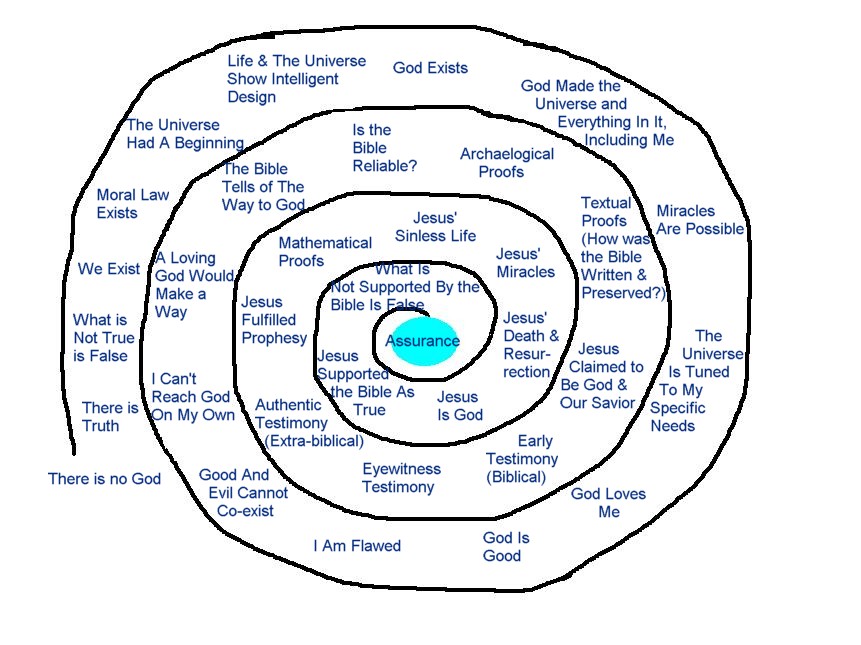
There is something called Spiral Reasoning. The idea is that you start with a knowable bit of information and you use philosophy, history, physical evidence, testimonial evidence, archaelogical evidence, etc... --always building on what you already know, one step at a time, until you reach the point where you are convinced of the truth. This will take time, mental energy and emotional energy, but the reward far outweighs the cost. I have included a diagram below that shows the steps that one might follow toward compelete assurance of Christ's existence, His sacrifice and His offer to you. It also shows the steps one takes to establish biblical reliability and the accuracy of historical records. (Unfortunately, it is pretty small on-screen, so you may have to download it or print it in order to read it properly. Sorry about that--but it's just another step in your search, right?)

How much faith is involved? I think that's a question only you can answer. Some people need more factual proofs. God knows that and made sure that there would be plenty available. Other people need very little evidence to beleive and are able to take more on faith. Regardless of where you fall within this spectrum, some amount of faith will be required. (Not, however, any more faith than is required to believe any of the alternatives.)

If you are a confirmed skeptic, it's unlikely that anyone, in a few minutes could give you everything you needed to know in order to fully believe in Jesus Christ. However, a skeptic should be a skeptic for a reason, right? If you haven't given the evidence a thorough look, how authentic would be your stance?

The fact is this: assurance--complete assurance is not only possible, it is what God desires for each of us. He made sure there was ample, abundant, over-flowing evidence to support the truth of His existence, His message and His offer to us. Won't you have a look?

Spiral Reasoning

Monday, September 25, 2006

Changing Perspective


Not long ago I was dressing up for some event and wanted to wear a certain pair of earrings. I went to get them from my jewelry box only to discover that one of them was missing. I looked all over the dresser and the floor, but couldn’t find the other one, so reluctantly chose a different pair. A couple of days later, I went through a similar search, but left frustrated. Later, I came back and decided to do a more thorough search. I searched the floor, felt under the cabinet and looked under the bed. I picked up everything on my dresser and looked under it. I rifled through every item there, but still couldn’t locate that crazy, rotten, little earring that now seemed to be hiding from me on purpose. I decided to give up again. I turned to go, but as I did so, took one last glance in the mirror. Suddenly, there it was! Right there, in the mirror, hanging from the backside of one of my glass candleholders, was my lost earring! How it got there, I didn’t know, nor care. I had finally found it!

Strange how we can be looking for something—even diligently searching for it—but it can still continue to elude us. I never considered using the mirror as a way to enhance my search—as a way of gaining a different perspective. And yet, even though I only changed my perspective for only a brief moment, my eyes immediately spotted the object of my search. I think our search for God can be very much like my search for my lost earring. We keep a picture in our mind of what we think He’s like, hoping that when we come across Him we’ll recognize Him. We look everywhere we think He might be hiding, only to discover He isn’t in any of those places. We become frustrated—even angry—that He is hiding from us (on purpose, of course) and decide to give up.

Consider for a moment, a different perspective on this issue. Consider the possibility that God isn’t hiding from us. Consider the possibility that God is actually trying to get our attention. Consider the possibility that the picture we have in our mind of what God is like is so flawed that we simply aren’t able to recognize Him when He shows Himself to us. I invite you to evaluate some of your ideas about God—recognizing them for what they are—and then try to think about them with me from a slightly different perspective. Perhaps, like my lost earring, God has actually been in plain sight all along.

Wednesday, September 06, 2006

The Cost of Following Jesus Christ


How much does it cost to be a Christian--a "follower of Jesus Christ"? Nothing and everything. The gift of God's forgiveness and acceptance is completely free, but also carries the highest price--your love and your trust.

This is a concept that is often misunderstood in non-Christian circles. Of course, it's not surprising, since they hear: "Jesus' love and forgiveness is a free gift", but then they see us going to church regularly, participating in all kinds of service projects, denying ourselves certain worldly pleasures and giving vast amounts of money to various Christian organizations. Sure seems like there's a price to me!

Here's an example, though, that might help clear this up a little:

We are like a baby bird in a nest. The nest is our comfort zone, where we can do whatever we like without having to believe in anything else or trust in anyone else (except for Mamma bird, but she just seems to show up at the right times and we don't know why--like our dependence on this beautiful world we live in).

However, eventually we must make a choice: leave the nest, get out on the branch where we're much less comfortable, or stay in the nest for the rest of our lives and stagnate. The choice is free to us and a relatively safe one. Yes, a great gust of wind could come up and knock us out of the tree, but while crawling out of the nest onto the branch, we're, at least, still on solid territory. This is like accepting Christ. It takes a step of faith, a risk. All we have to do, though, is to believe in Him--to accept His forgiveness for our sins, to trust in His promises to meet us where we are and to grow us in Him throughout the days, weeks and years to come--to never leave us. At that moment, sitting there on the branch, we're what Christians call "saved". All of the mysteries and promises and gifts of God are, at that moment, fully available to us. We are in His grace and in open communication with God. If we were to die at that moment, heaven would be ours, no matter what misdeeds we'd committed in the past.

But, let's say we don't die then--at the moment of belief. What happens next? Here's where the cost comes in. We're sitting on that branch, out of the nest, but very worried about what comes next. Well, then Mamma bird (God) comes up behind us and gives us a nudge. We fight back, not wanting to leave our safe perch, and we somehow manage to keep our talons securely on the branch. Being out of the nest is enough, right?

Mamma bird gives us another nudge. This time she's more insistent. We fight back and scoot farther down the branch away from her. What is she trying to do, anyway? Kill me? Hasn't she seen how far a drop it is? She must be nuts!

Again, though, here she comes! We brace ourselves, but this time she nudges us so hard that we loose our grip and start to fall. Is this why we got out of the nest? Just to fall? What a terrible trick! But then something happens that we didn't expect. We realize that we have wings. We open them and begin to fly. Suddenly, we realize that sitting in the nest and sitting on the branch were nothing compared to the miracle of flight! What glory! What exhilaration! So, this is what Mamma wanted for us all along!

Is there a cost? Certianly! It costs you everything! It costs your love, your trust and your utter dependence. What is there in life that has more value than these things? I can't think of a thing. This is what God demands from us--everything of value.

When we say that there's no cost, we mean that belief is a choice that you make. It doesn't cost you any money; it doesn't cost you good works; it doesn't cost you any time; it doesn't cost you any fixing up of yourself beforehand. The gift is free in this regards, because love and trust are not a commodities. God will accept you exactly how you are at that moment, no matter what you've done in the past or how you are choosing to live your life today. ...But He won't leave you how He finds you. He desires so much more for your life! He wants us to fly--no, soar! Can you trust Him to guide you one step at a time?

Thursday, August 17, 2006

Can I Convert You?


Recently I have been dealing with a misconception that I think is circulating in both Christian and non-Christian circles. (That Christians have the power to convert people to their belief system.) It was brought to mind poignantly by a recent question addressed to me by one of my blog visitors. He asked, "...how do you know that you could tell them [unbelievers] the one thing that would bring them closer to God?"

There are three problems here: 1, I never said I could do such a thing, 2, I don't beleive I could ever do such a thing, and 3, that was never the purpose of my "spritual thought" entries or for anything else I've said on this blog.

As a Christian, I study and believe the Bible as the Word of God--His message to men (and women). So, here's how I back up my stance on this particular issue: The Bible states, "Therefore once more I will astound these people with wonder upon wonder; the wisdom of the wise will perish, the intelligence of the intelligent will perish." (Isaiah 29:14, NIV)

I Corinthians 1:18 through chapter 2 also has a lot to say about this concept--the idea that spiritual wisdom is from God, not from man. It is very clear to point out that what we consider to be a wise, eloquent or convincing arguements have absolutely no power unless the Spirit of God reveals Truth to the individual whose heart is seeking.

I Corinthians 2:10-11 states, "...The Spirit searches all things, even the deep things of God. For who among men knows the thoughts of man except the spirit within him? In the same way no one knows the thoughts of God except the Spirit of God."

If there is something in what I write that touches you, speaks to your heart, makes you curious to learn more about God or, even, convicts you--PLEASE MAKE NO MISTAKE--It has absolutely nothing to do with me! I know this fully. That is God speaking to you, trying to get your attention. My words are fallible, God's spirit is not. My words are, of themselves, powerless, God's Spirit is all-powerful. My words, left on their own, are foolishness, but God's Spirit reveals wisdom.

So, what is my purpose for drumming up spiritual thoughts to chew on? My purpose is three-fold: 1, to obey God--to do what I believe He wants me to do as He told me through the Scriptures (spread the gospel of Christ-Matthew 28:18-20 & John 4:35), 2, use my writing for what I believe God's purpose was for giving me the talent and, 3, give you something to think about, wonder about & discuss. Since the Bible tells us that those who seek will find (Matthew 7:7-8), if I can help you to actually start seeking, God will lead you through the rest of the process.

So, can I covert you?
Absolutely not! Conversion is a change of heart. I can't change hearts, no matter how much I might wish I could sometimes. If there's any converting, changing, learning, gowing, etc. to be done, that's between you and God.

So, please don't assume that I expect to convert you or even change your mind on a particular issue just because I speak in a confident voice about what I believe. Be secure in the fact that I don't expect you to change your mind just because I told you to. If you read something here that softens your heart or opens your eyes to a new spiritual truth, please blame God for that, not me. Don't accuse me of such a thing; go take it up with Him.

Saturday, July 08, 2006

10 Theoretical Statements Christians and Atheists Can Agree On

1. We cannot "conjure up" God. If there is a God--a Supreme Being of some sort--we would not define His characteristics any more than we get to decide what the stranger moving in next door is going to be like. God defines Himself.

2. It is wrong to try to convince ourselves to believe in God. If there is a God who is all-powerful and interested in humanity, He would be able to communicate with us. He would be able to prove His own existence to us. We don't have to pretend to believe in a God that has no real power to connect with us on an intimate level.

3. If there is a God that is all-powerful and all-knowing, we, as limited beings that exist within time, would never be able to comprehend everything about Him. We would only be able to understand what He enables us to understand.

4. If God exists and if God is perfect, He would also be changeless. Perfection cannot be improved upon. Therefore, God would have no need to change Himself (i.e. His nature.)

5. If God is perfect and if God loves us, nothing we could do would ever make Him love us any less and nothing we could do would ever make Him love us any more. If perfect love exists, it would be a changeless love.

6. If there is a God who made me and who is all-knowing, He would know my innermost thoughts and desires. I would be, in some way, accountable to Him. He would want to have some kind of influence in my life. He must, therefore, also be, in some way, accessible to me.

7. If God is truly good, He would be extremely grieved by the evil that is so prevalent in our world. He wouldn't be able to sit by and do nothing; He would have to do something about it.

8. If God is truly perfectly good, there is no way I, in my imperfection, could ever be with Him or figure out how to reach Him. If there is a way, He must have provided it. I could not come up with it on my own. It would be foolishness to think that, in a relationship between a perfect being and an imperfect one, the perfect being would expect the imperfect one to do all the work, make all the decisions and figure out on its own how to attain perfection. It would be like asking your newborn baby to build a vehicle out of the junk in your garage, get behind the wheel and drive to Malaysia. It's just not going to happen. We can't reach God--no matter what we do (or don't do). He has to reach us.

9. If a relationship with God is possible, the start of that relationship and the maintenance of that relationship would be strictly between God and the individual. In other words, no one else--not a pastor, a friend, a family member or a religious institution--could handle the responsibility of maintaining it. You are not spiritually accountable to anyone but God (unless you choose to be).

10. For the biblical account of the origins of the earth and humanity to be true, they cannot contradict proven scientific facts. If God set up the world and nature and science, His account of it, if taken seriously, would help explain things, not cause greater confusion.